
I’ve stood in the dog food aisle staring at a bag that says “high-protein, grain-free, all-natural” and had absolutely no idea if any of that mattered for my own Bulldog. That confusion is basically the whole industry’s business model — vague, feel-good words on the front of the bag, and actual nutrition information buried in tiny print on the back. So let’s start with dog nutrition basics the way I wish someone had explained them to me: not brand names, not marketing claims, just what your dog’s body actually needs.
The Three Macronutrients: Dog Nutrition Basics Explained
Every dog food, no matter how it’s marketed, comes down to three macronutrients: protein, fat, and carbohydrates. Here’s the part that surprised me when I first looked into it properly.
Protein builds and repairs muscle, skin, coat, and just about every tissue in your dog’s body. It’s made of amino acids, and dogs can’t produce all of them on their own — ten have to come from food. This is the one macronutrient regulatory bodies are strictest about, and for good reason.
Fat isn’t the villain a lot of pet owners assume it is. It’s the most energy-dense nutrient, it carries fat-soluble vitamins (A, D, E, K) around the body, and it supplies essential fatty acids your dog’s body can’t make on its own.
Carbohydrates are the one nobody quite agrees on. According to the National Research Council (NRC) — the scientific body that publishes nutrient requirement data used across the pet food industry — adult dogs don’t actually have an established dietary carbohydrate requirement. Carbs are mainly there as a practical, affordable energy source that spares protein and fat from being burned for fuel instead of used for tissue repair and hormone production. That doesn’t make carbs “bad” — it just means the “grain-free is automatically healthier” marketing angle oversimplifies what’s actually going on nutritionally.
Life Stage Changes Everything
This is the part of dog nutrition basics that trips up even attentive owners: a diet that’s perfectly balanced for one life stage can be inadequate — or excessive — for another.
The Association of American Feed Control Officials (AAFCO) sets minimum nutrient standards that pet food must meet to legally claim it’s “complete and balanced.” There are two core profiles:
| Life Stage | Minimum Protein | Minimum Fat |
|---|---|---|
| Adult Maintenance | 18% (dry matter basis) | 5.5% |
| Growth & Reproduction (puppies, pregnant/nursing) | 22.5% | 8.5% |
Puppies need meaningfully more of both to support rapid tissue growth and skeletal development — this isn’t a marketing distinction, it’s a real, regulated difference.
Here’s the honest gap in the science, though: neither AAFCO nor the NRC has an official “senior” nutrient profile. Despite every pet food aisle having a “senior formula” bag, there’s no regulated standard defining what that should actually contain — it’s left entirely to each manufacturer’s discretion. A recent analysis of over-the-counter adult and senior dog diets found wide variability in nutrient composition between brands marketed for seniors, precisely because there’s no shared definition to formulate against. If your dog is getting older, “senior formula” on the label tells you less than you’d think — a conversation with your vet about your dog’s specific bloodwork matters more than the bag’s marketing.

Fat Isn’t the Enemy: Essential Fatty Acids
All dogs have a dietary requirement for linoleic acid, an omega-6 fatty acid found in vegetable oils — their bodies can’t synthesize it. Puppies additionally need arachidonic acid, another omega-6 found in animal fat, to support proper development.
Omega-3s — particularly DHA — matter most during puppyhood, where research points to a role in brain and retinal development. For adult dogs, many veterinary nutritionists suggest maintaining a reasonable balance between omega-6 and omega-3 intake (commonly cited ranges fall somewhere between 2:1 and 6:1), since a lot of conventional chicken-based diets skew heavily toward omega-6 without much omega-3 to balance it. That said, “ideal ratio” recommendations vary by source and aren’t as rigidly standardized as the protein/fat minimums above — it’s a reasonable target, not a hard rule. This balance is one of the more nuanced pieces of dog nutrition basics, since it isn’t governed by the same hard-and-fast standard as protein and fat minimums.
Reading the Label: What the AAFCO Statement Actually Tells You
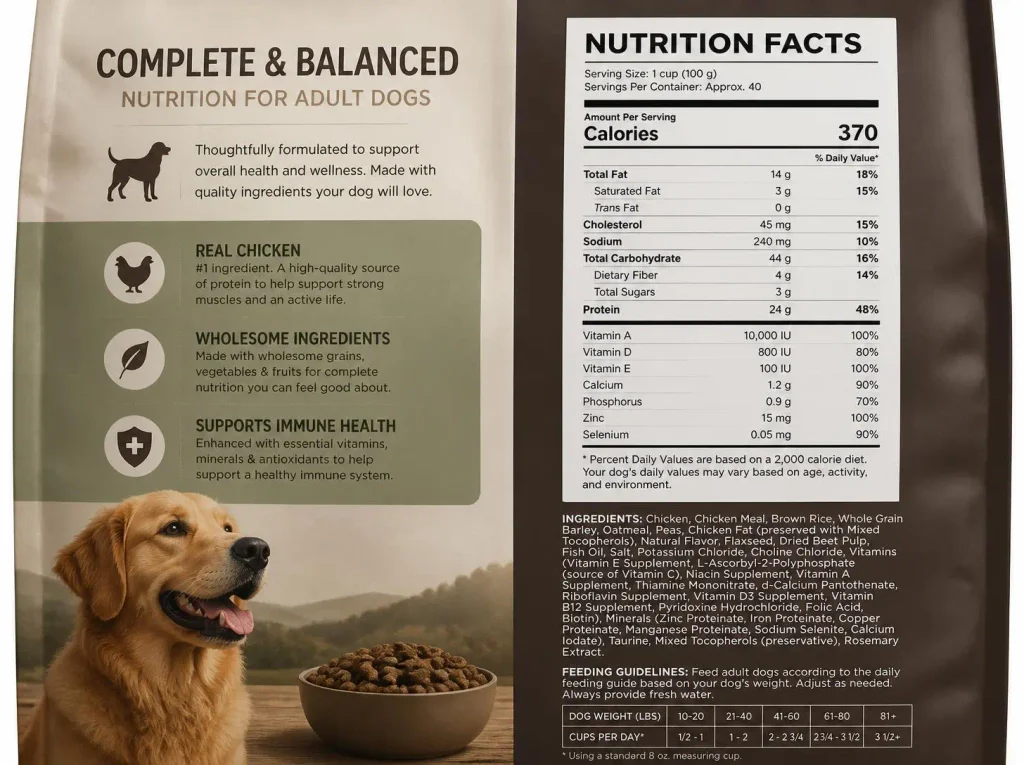
Every complete and balanced dog food is required to carry an AAFCO nutritional adequacy statement, and it’s genuinely one of the most useful things on the bag — more useful than the ingredient list, honestly. Look for phrasing like:
- “Formulated to meet AAFCO Dog Food Nutrient Profiles for [life stage]” — meets minimum standards on paper, based on nutrient calculation
- “Animal feeding tests using AAFCO procedures substantiate that this product provides complete and balanced nutrition” — this one means the formula was actually tested by feeding it to dogs, not just calculated to meet a nutrient target on paper
If a bag is for “all life stages,” that means it meets the stricter Growth & Reproduction profile — which is fine for a young, active dog, but may be more than a sedentary senior actually needs.
Guaranteed Analysis vs. Ingredient List: What Actually Matters
Two other parts of the label matter just as much as the AAFCO statement, and both get misread constantly.
The Guaranteed Analysis panel lists minimum percentages of crude protein and crude fat, and maximum percentages of crude fiber and moisture. It’s useful for a rough comparison between products, but it’s not directly comparable between a dry food and a wet food unless both are converted to a dry-matter basis first — a canned food’s “10% protein” looks dramatically lower than a kibble’s “25% protein” purely because canned food contains far more moisture, not because it’s actually lower in protein once the water is accounted for.
The ingredient list is ordered by weight before cooking or processing, which is a blurrier metric than most people assume. A food listing “chicken” first can still end up mostly grain-based by the time you account for how much water cooks out of that chicken versus how many separate grain ingredients sit further down the list, each contributing a smaller individual amount. This is one of the more genuinely misleading conventions in pet food labeling, and it’s a big part of why dog nutrition basics really has to start with nutrient minimums and life stage, not ingredient order.
How Much Should You Actually Feed?
This is where dog nutrition basics gets personal — general guidelines only go so far. This is genuinely one of the harder questions to answer in general terms, because calorie needs depend on weight, activity level, spay/neuter status, and breed-specific factors. My own Bulldog is a good example of why “just follow the bag” doesn’t always work — brachycephalic breeds tend to have lower exercise tolerance due to their airway structure, and many run a bit more sedentary than the “average” dog the feeding chart on the bag was calculated for. Following the generic feeding guideline to the letter left mine trending toward overweight, which matters a lot for a breed that already carries extra joint and breathing strain.
The feeding chart on the bag is a reasonable starting point, not a precise prescription. If you’re not seeing your dog maintain a healthy weight at the recommended amount, that’s a conversation for your vet, not a reason to guess at a bigger or smaller portion on your own.
A Rough Way to Estimate Calories
If you want a ballpark sense of daily calorie needs, most veterinary nutrition references start with the Resting Energy Requirement (RER) formula: 70 × (body weight in kg raised to the 0.75 power). From there, an activity multiplier is applied — commonly somewhere around 1.2 to 1.4 for a typical neutered adult dog at a healthy weight, higher for very active or intact dogs, and lower for overweight dogs on a weight-loss plan or for breeds that tend to run more sedentary.
This is meant as a starting point for a conversation with your vet, not a number to follow rigidly on your own — individual metabolism varies more than any formula accounts for, which is exactly why the bag’s feeding chart and this kind of calculation are both estimates, not prescriptions.
Switching Foods Without Digestive Chaos
Even a genuinely well-formulated new food can cause loose stool or vomiting if you switch too fast — a dog’s gut needs time to adjust to a new ingredient profile. The commonly recommended approach is a gradual transition over 7 to 10 days: starting around 25% new food mixed with 75% old, then shifting the ratio every couple of days until fully transitioned. If digestive upset shows up partway through, slowing the transition down further — rather than abandoning the new food after one bad day — is usually the more useful troubleshooting step. Ongoing or severe symptoms, though, are a reason to call your vet rather than push through it.
Where the Evidence Gets Murky
To be fair to the uncertainty here: a lot of popular pet nutrition claims run ahead of the actual research. “Human-grade” ingredient sourcing is a real, defined manufacturing standard, but it’s a separate claim from “complete and balanced” — a food can be one without the other. Raw feeding, grain-free formulations, and boutique “ancestral diet” framing all have passionate advocates, but the evidence quality behind many of these specific claims is thinner than the marketing suggests, and some (notably certain grain-free formulations) have been the subject of ongoing veterinary cardiology investigation regarding a possible link to diet-associated heart disease in some dogs. That’s a nuanced, evolving area of research — not something to treat as settled in either direction.
Signs Your Dog’s Diet Might Not Be Working
A dull coat, low energy, chronic soft stool, or unexplained weight changes can all be diet-related — but they can also signal an unrelated health issue entirely. This pillar isn’t the place to diagnose that in detail (that’s its own guide), but the short version is: don’t assume it’s “just the food” without ruling out other causes first. Getting the fundamentals of dog nutrition basics right from the start makes these edge cases much easier to spot when they do come up.
Bottom Line
Dog nutrition basics really comes down to three things: protein and fat minimums that shift meaningfully by life stage, carbohydrates that are more about energy economy than a hard requirement, and a label that actually tells you more than the ingredient list does if you know what to look for. Beyond that, your dog’s individual body condition, breed-specific quirks, and vet guidance matter more than any specific brand or diet trend.
Editorial Note & Disclaimer
This article is based on publicly available nutrient standards from AAFCO and the National Research Council (NRC), veterinary nutrition literature, and Maddie’s own experience navigating feeding decisions for her Bulldog. This is not veterinary advice — if your dog has a health condition, is over- or under-weight, or you’re considering a significant diet change, please consult a veterinarian before making changes.