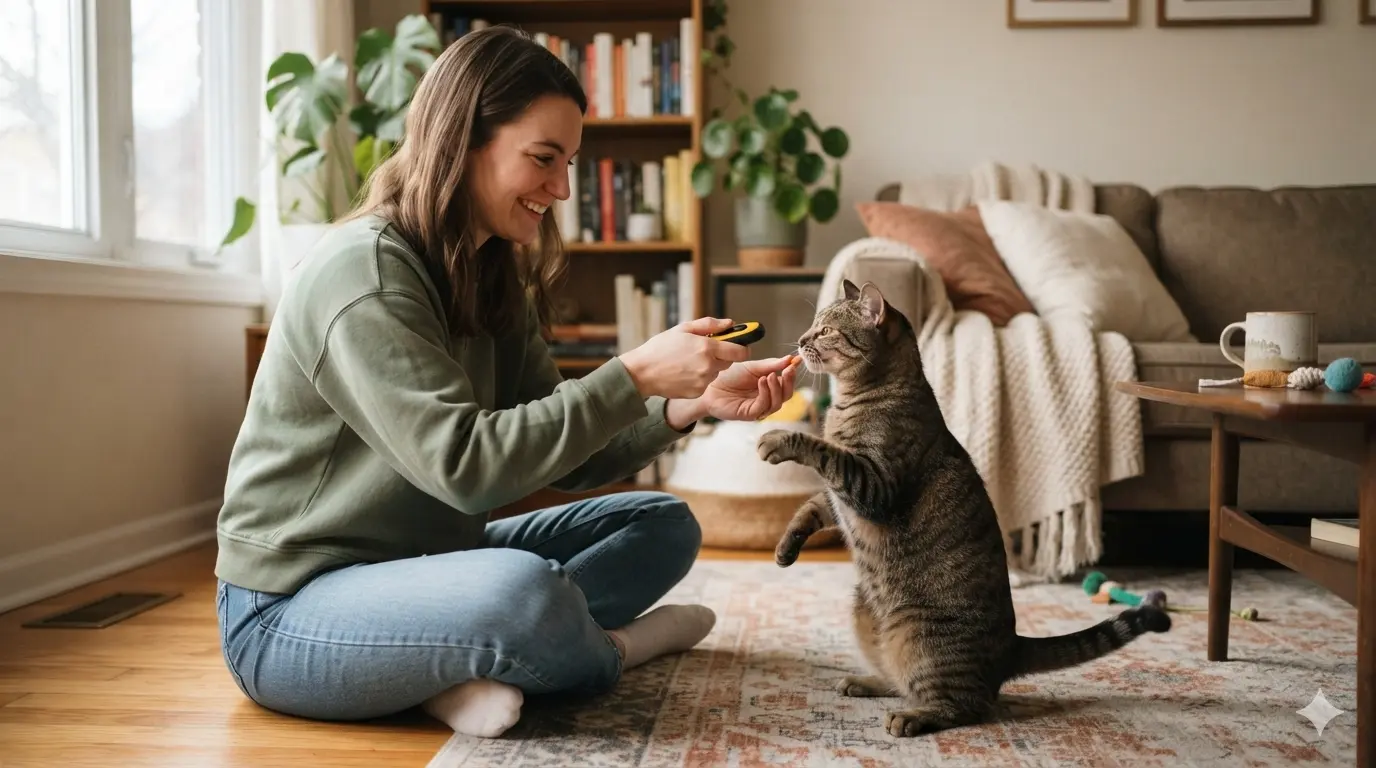
Our Cat Training guide covers reward-based training at a high level, but the mechanics underneath deserve their own space — because most people who say “cats can’t be trained” are actually running into a timing, motivation, or environment problem rather than a real limit on what a cat can learn. Moose is the kind of cat who will happily ignore a cue for weeks and then demonstrate it perfectly the moment the reward is good enough, which taught me more about how this works than any guide did.
Understanding Positive Reinforcement Cat Training: The Actual Mechanism
The mechanism is simple to state: a behavior happens, something the cat wants happens immediately afterward, and the behavior becomes more likely to happen again. The complication with cats specifically is that they’re generally less motivated by pleasing their owner than dogs tend to be, which means the “something the cat wants” has to actually be something the cat wants — not something the owner assumes a cat should want.
Timing: Why It Matters Even More for Cats
A reward delivered even a couple of seconds late risks reinforcing whatever the cat is doing at that moment rather than the behavior you meant to reward. Cats also tend to move on to something else faster than a dog waiting expectantly for a treat, so the window for well-timed reinforcement is often shorter. This is exactly why markers exist: a clicker or a consistent verbal marker can be delivered instantly at the exact moment of the correct behavior, then followed by the actual treat a moment later.
Practically, that means having the reward ready before a session starts rather than fumbling for a treat after the cat has already done the right thing. Keeping treats in a pocket or a small container within easy reach, and starting each session with a few pre-portioned pieces, removes the most common cause of late reinforcement — the owner simply not being ready when the moment arrives.
Clicker Training for Cats
A peer-reviewed study assessing clicker training in shelter cats found that cats could learn new cued behaviors within a relatively small number of short sessions using positive reinforcement alone, and that age and sex didn’t meaningfully affect learning ability — suggesting the method works across a broad range of cats, not just naturally food-driven ones. Food motivation and individual temperament, though, did predict how quickly a specific cat progressed.
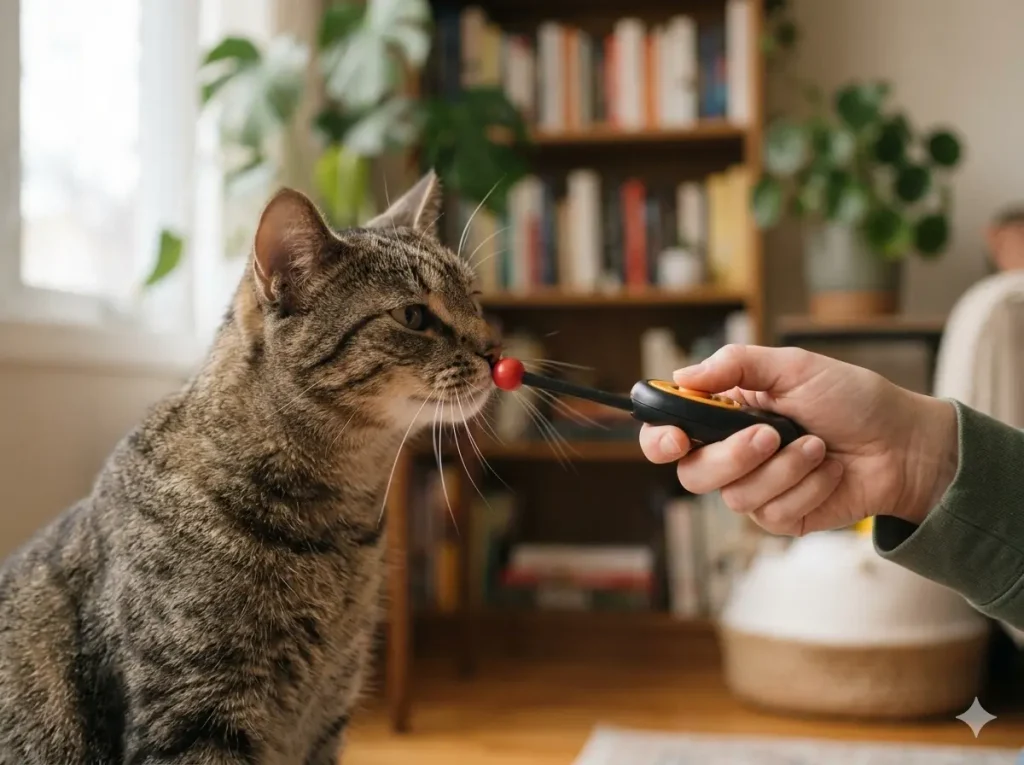
It’s worth noting that research on clicker training in general — including in dogs — hasn’t consistently shown the clicker itself to be superior to other consistent markers like a short verbal cue. What matters most is that the marker is delivered accurately and consistently, and that the cat has learned to associate it reliably with a coming reward.
Teaching the Marker
Before a marker can do its job, a cat needs to learn what it means. The simplest approach is to pair it with a treat repeatedly with no behavior required at all — click, then treat, over and over across several short sessions — until the cat visibly reacts to the sound by looking toward where the treat comes from. Only once that association is solid does it make sense to start using the click to mark specific behaviors. Skipping this step and jumping straight to marking behaviors is one of the most common reasons clicker training seems not to work for a particular cat, when the actual problem is that the cat hasn’t yet learned the sound predicts anything.
Reward Value: Finding What Your Cat Actually Wants
Cats tend to be pickier about rewards than dogs, and everyday kibble often isn’t motivating enough for training work. Finding what a specific cat will genuinely work for — a small piece of cooked chicken, a lickable treat, a favorite freeze-dried option — makes training sessions far more productive than assuming any treat will do. Rotating between a few high-value rewards prevents a cat from getting bored of the same one, and saving the best option for harder tasks keeps motivation high when it matters most.
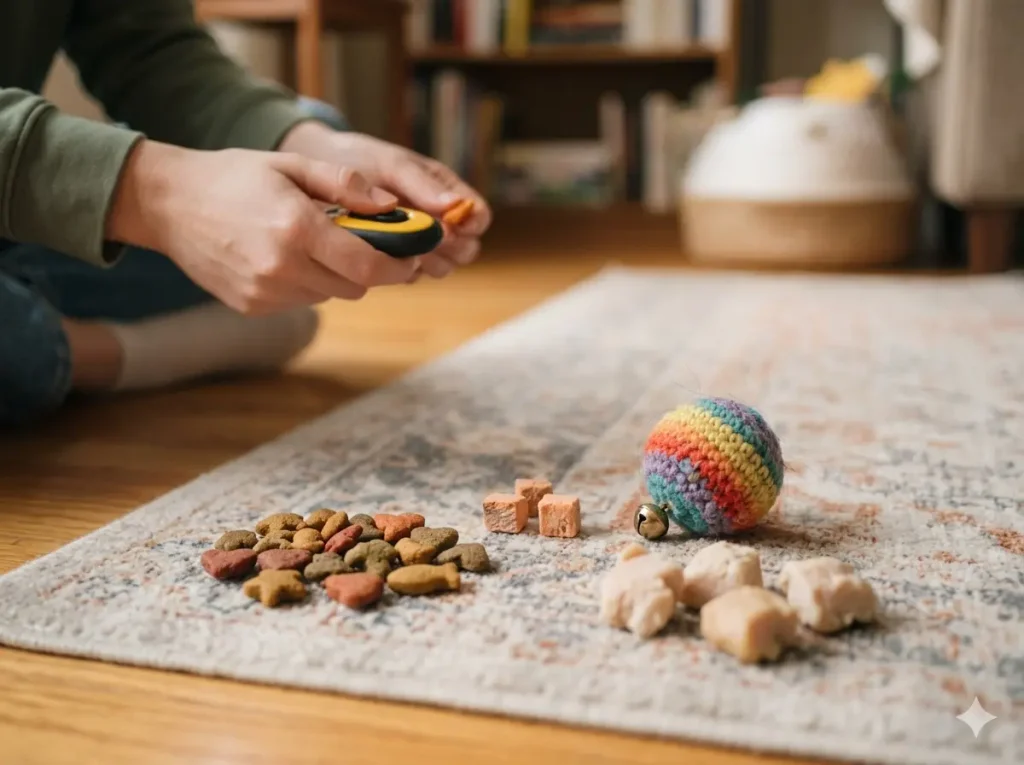
Portion size matters more than owners often realize. A treat that’s too large fills a cat up quickly and ends the session early, while tiny pieces (roughly pea-sized or smaller) let a cat get many repetitions in before losing interest. Adjusting daily meal portions slightly on heavy training days also helps prevent training treats from quietly adding up to unwanted weight gain over time, especially for a breed like Moose that’s already prone to putting on weight if activity drops.
Not every cat is motivated by food, and some are far more interested in play or attention. A cat who doesn’t respond to treats might work for a favorite toy, a short play session, or gentle petting, provided the cat genuinely enjoys the interaction rather than tolerating it. Experimenting across several reward types over the first few sessions — and watching which one produces the most eager, engaged response — tends to reveal a cat’s actual preference faster than assuming based on what most cats like.
Common Mistakes That Undermine Positive Reinforcement in Cats
A few patterns quietly sabotage reinforcement-based training even when the overall approach is sound: sessions that run too long (cats tend to lose interest faster than dogs, so a few minutes is usually plenty), attempting to train in a stressful or overstimulating environment, and forcing interaction when a cat clearly isn’t interested — a cat who walks away from a session is telling you something, and ignoring that signal tends to make the next session harder rather than easier.
Another common issue is inconsistency in what a cue means. If “come” sometimes means a treat and sometimes means being picked up for a nail trim, a cat quickly learns that the cue is unreliable — or worse, unpleasant. Keeping a cue tied to consistently good outcomes, and using a different cue or approach for less welcome activities like carrier loading or medication, protects the reliability of the behavior over the long term.
Punishment-based approaches are also particularly ineffective and often counterproductive with cats. Cats don’t reliably connect a correction to a specific past behavior, and punishment tends to create fear or avoidance of the owner rather than teaching the intended lesson.
When Physical or Mental State Affects Learning
A cat who’s overtired, stressed, or lacking adequate rest doesn’t learn well regardless of how well the reinforcement mechanics are executed. Our Cat Exercise by Life Stage guide covers how activity needs shift across a cat’s life, and our Rest Space for Your Cat guide covers why a secure, uninterrupted retreat matters for overall wellbeing — a cat whose basic needs for rest and play aren’t being met is often a harder training subject not because the method has failed, but because their capacity to focus and engage is compromised.
Timing sessions around a cat’s natural activity peaks tends to help a lot. Many cats are most alert and receptive around dawn and dusk, and least interested in the middle of a typical nap period — scheduling a short session shortly before a regular mealtime, when a cat is naturally hungry and food-motivated, often produces noticeably better engagement than the same session attempted right after a full meal.
Where This Fits Into Everything Else on Furrowise
This guide expands on the reinforcement mechanics touched on in our Cat Training guide, and pairs with our Cat Training by Life Stage guide for how these mechanics apply differently across a cat’s age. For the physical and rest-related factors that affect how well a cat can engage with any training session, our Cat Exercise by Life Stage guide and Rest Space for Your Cat guide cover the underlying needs.
Editorial Note: This article draws on a peer-reviewed study on clicker training in shelter cats, veterinary and behavioral guidance on feline learning, and editorial analysis of that material. It is not based on hands-on testing of any product.
Disclaimer: This article is not veterinary or professional behavioral advice. If your cat shows sudden changes in behavior, avoidance, or signs of stress, please consult a vet or a certified animal behaviorist.