
Our Cat Lifestyle Needs guide covers environmental enrichment as one of the five pillars cats need, but doesn’t get into specific products. This guide does — the categories of cat enrichment toys that are actually backed by something more than marketing copy, what to look for within each one, and where Moose’s size has meant standard options didn’t quite cut it. None of this is about buying every product in every category; it’s about knowing which categories are worth the money and which ones a specific cat is likely to actually use.
Understanding What Makes Cat Enrichment Toys Effective
Cats are hunters by design, and most effective enrichment mimics some piece of the hunting sequence — stalking, chasing, pouncing, or the mental work of extracting food that isn’t just sitting in a bowl. A large survey of cat owners published in the Journal of Feline Medicine and Surgery found that a meaningful share of respondents already use food puzzles specifically because they tap into this foraging instinct, and separate research reviewing food puzzle use has described benefits including reduced problem behaviors in some case studies. The throughline across most legitimate cat enrichment toys isn’t complexity or price — it’s whether the toy lets a cat actually perform some version of a natural behavior they’d otherwise have no outlet for indoors.
Food Puzzles: What to Look For
Food puzzles range from simple to genuinely difficult, and matching difficulty to a specific cat matters more than picking the “best” one on a review site.
Stationary puzzles (fixed bases with compartments or holes a cat fishes food out of) tend to be the easiest entry point — good for cats who’ve never used a puzzle before, or for wet food, which doesn’t work in rolling designs.
Rolling or mobile puzzles (balls or cylinders a cat pushes around to release kibble) add a physical activity component on top of the mental one, which can be useful for cats who need more movement, not just more mental stimulation.
DIY options — a bottle with holes cut for kibble to fall through, an egg carton with treats hidden in the cups — are a genuinely reasonable starting point before spending money on a commercial version, since some cats need time to learn that a puzzle even contains food at all.
Not every cat takes to puzzle feeding immediately. Starting with an easy puzzle, keeping a portion of the meal in a normal bowl at first, and increasing difficulty gradually tends to work better than switching a cat’s entire meal to a hard puzzle on day one.
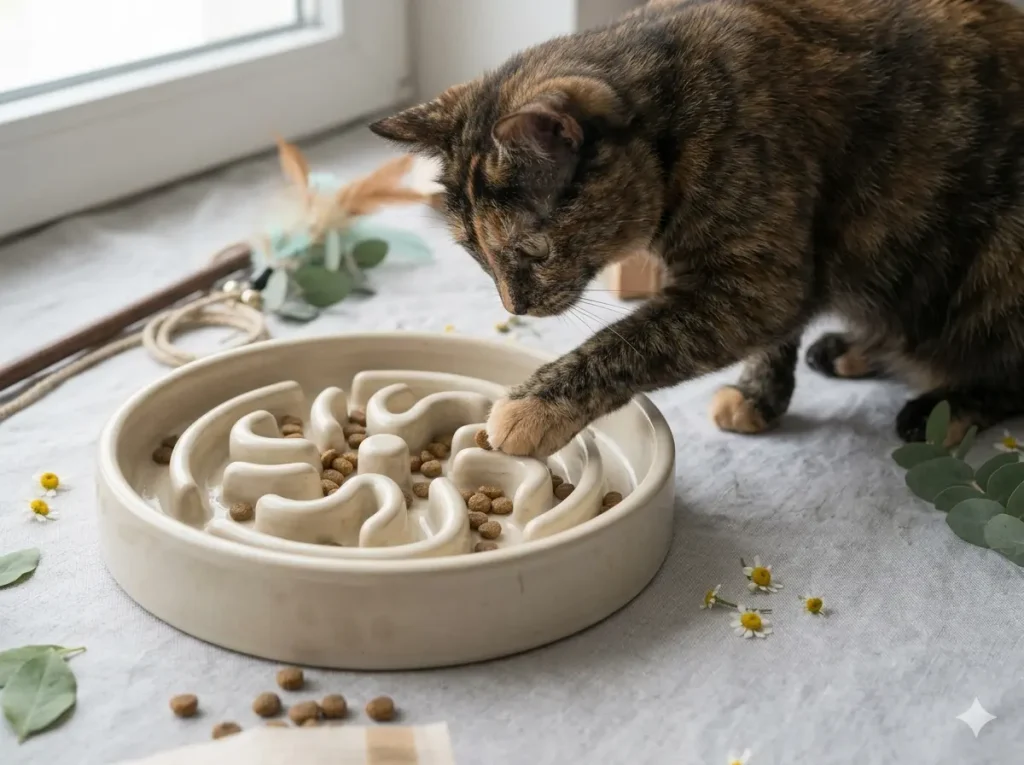
Matching Puzzle Difficulty to Your Cat
A cat’s age, food motivation, and prior experience with puzzles all affect how quickly they’ll progress. Kittens and highly food-motivated cats often figure out even moderately difficult puzzles within a few tries, while an older cat who’s eaten from a plain bowl their whole life may need weeks of easy-puzzle practice before a harder design makes sense. A reasonable progression looks like: a simple stationary puzzle with large, easy-access compartments first, then gradually smaller openings or a rolling design once the cat is reliably engaging with the easy version. Rushing this progression is one of the more common reasons a puzzle ends up abandoned in a cupboard rather than in regular rotation.
For multi-cat households, food puzzles add a layer of complexity worth planning for: a single puzzle can become a source of competition or guarding behavior if cats have to share it, so separate puzzles per cat — even simple, inexpensive ones — tend to work better than one shared “enrichment station.”
Cat Enrichment Toys:Wand Toys and Predatory Play Toys
Wand toys let an owner control movement in a way that mimics actual prey behavior — darting, pausing, retreating — which tends to hold a cat’s interest longer than a toy that just sits there. The research-backed detail worth knowing: ending a play session by letting the cat actually “catch” the toy (rather than pulling it away every time) completes the predatory sequence and tends to leave cats more satisfied than an interrupted chase with no resolution.
Feather wands specifically need supervision — feathers and the small attachment pieces are a genuine ingestion risk if left out for unsupervised chewing, so most are designed for supervised play sessions rather than as toys to leave out permanently.
How Long and How Often
Most cats do well with two to three short play sessions a day rather than one long one — five to ten minutes of genuinely engaged play tends to be more satisfying than a longer session where the cat’s attention has already wandered halfway through. Watching for signs a session is winding down (slower chasing, less intense focus, walking away) and ending on that note, ideally with a “catch,” tends to leave a cat more satisfied than continuing past the point of real engagement.
Scratching Posts and Vertical Enrichment
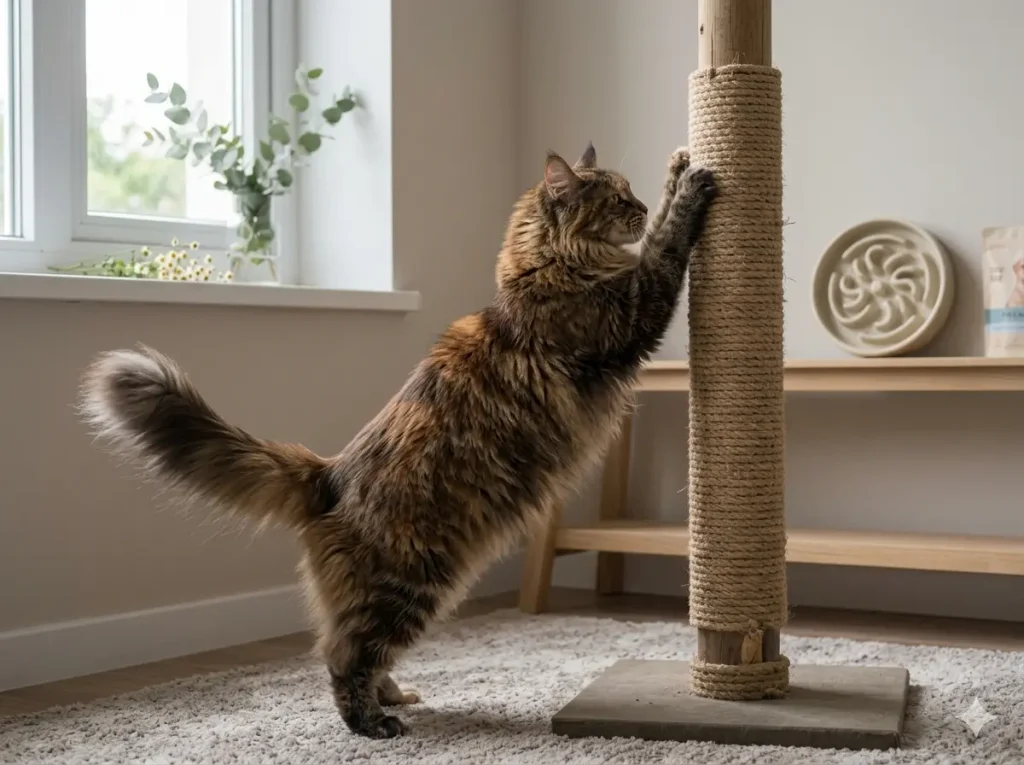
Our Cat Training guide covers the training side of scratching post use, but the product itself matters just as much as the training. A post that’s too short, too wobbly, or covered in a texture a specific cat doesn’t like will get ignored regardless of how well the placement and reward timing is handled. Sisal rope or sisal fabric tends to be the most consistently preferred texture across cats, and height/stability matter more than most owners initially budget for — a post that tips or wobbles during use often gets abandoned even if the cat initially showed interest.
Vertical space more broadly — cat trees, wall-mounted shelves, window perches — serves a similar enrichment function by giving a cat elevated vantage points and a way to survey their territory, which ties directly into the “safe place” and territorial-security pieces of overall cat wellbeing.
Catnip, Silvervine, and Scent-Based Enrichment
Not all cats respond to catnip — sensitivity is inherited and roughly a third of cats show no reaction at all. Silvervine is worth knowing about as an alternative, since some cats who don’t respond to catnip do respond to it, and vice versa; trying both before assuming a specific cat simply “doesn’t like” scent-based toys avoids ruling out a whole enrichment category unnecessarily. For cats who do respond, rotating catnip or silvervine toys in and out (rather than leaving them out permanently) tends to keep the response from fading with overexposure.
Automated and Interactive Toys
Motorized toys — robotic mice, automatic laser toys, apps that control a toy remotely — solve a real problem (a cat needing stimulation while an owner is at work) but come with a caveat worth taking seriously: unsupervised laser toys in particular have no physical object for a cat to “catch” at the end, which can leave some cats chronically frustrated rather than satisfied if lasers are the only form of play offered. Pairing an automated toy with at least some supervised physical-toy play, rather than relying on it exclusively, tends to give a more complete outlet.
Battery life, noise level, and how easily a toy can be reset or refilled without a full manual reset are the practical differences that tend to separate a genuinely useful automated toy from one that ends up unused after the first week. A toy that requires an owner to manually reposition it after every use defeats much of the “works while I’m away” purpose it was bought for.
Size Matters: Enrichment for Large-Breed Cats
Moose has made this section necessary in a very literal sense — a standard scratching post rated for an average domestic shorthair didn’t have the height or base stability to handle a large Maine Coon’s full-body stretch-scratch, and got knocked over within days of use. The joint considerations we cover in our Cat Lifestyle Needs guide for large-breed cats apply here too: cat trees and perches for a bigger cat need wider platforms and sturdier construction, not just a taller structure, since a large cat landing on an undersized platform is both a knocked-over-furniture problem and a minor fall risk. Checking a product’s specified weight rating before buying — rather than assuming “for cats” means “for any cat” — matters more for large breeds than it does for an average-sized cat.
What to Avoid
A short list of enrichment products worth skipping or using with extra caution:
- Toys with small, detachable parts (bells, feathers, plastic eyes) left out for unsupervised play — these are a real choking and ingestion risk, more appropriate for supervised sessions only
- String, ribbon, or yarn as unsupervised toys — a classic and genuinely dangerous category; linear foreign bodies can cause serious intestinal injury if swallowed
- Extremely difficult puzzles introduced as a cat’s first experience with foraging toys — this tends to create frustration rather than engagement, and can put a cat off puzzles generally
- Cheap, unstable scratching posts — a post that tips over on first use can make a cat wary of using it again even after it’s stabilized
How to Prioritize Spend
If starting from scratch, a sturdy scratching post and a basic wand toy cover the two highest-value categories for most cats — physical activity and a natural outlet for scratching behavior. A simple food puzzle is a reasonable second purchase, especially for cats who eat quickly or seem under-stimulated during the day. Vertical space (cat trees, shelves) and scent-based toys are worth adding once the basics are in place, particularly in multi-cat households where extra vertical space also reduces competition for territory.
Rotating Toys to Keep Enrichment Working
Novelty matters more for cat enrichment than most owners initially plan for — a toy left out permanently tends to fade into background scenery within a couple of weeks, regardless of how engaging it was on day one. Keeping a modest rotation (three or four toys in active circulation, with a few more in storage swapped in periodically) tends to keep the same toys feeling fresh far longer than buying more toys and leaving all of them out simultaneously. This applies to food puzzles too — swapping between two or three different designs prevents a cat from fully solving one puzzle to the point that it no longer requires any real effort. It is not about having a large number of puzzle toys for cats, but rather using them effectively.
Frequently Asked Questions
How do I know if my cat needs more enrichment? Signs like excessive vocalizing, destructive scratching outside of designated posts, overgrooming, or a generally “bored” restless pattern (pacing, following you room to room without settling) can all point to under-stimulation, though they can also have medical causes — ruling out a health issue with your vet is worth doing before assuming it’s purely a lack of enrichment.
Is it worth buying expensive toys, or do cats prefer simple ones? Aggregated owner and shelter experience consistently suggests cats respond more to how a toy moves and whether it lets them complete a hunting sequence than to price point — a $3 wand toy used well often outperforms an expensive toy left sitting on the floor.
My cat ignores every toy I buy — what am I doing wrong? Not every cat is naturally toy-motivated, and some take longer than others to engage with anything new. Trying a genuinely wide range of categories (texture, movement type, scent) before concluding a specific cat “doesn’t like toys” is worth doing — but it’s also fair to accept that some cats are simply lower-drive players, and that’s not a problem to fix.
Where This Fits Into Everything Else on Furrowise
This Cat Enrichment Toys buying guide expands on the environmental enrichment section of our Cat Lifestyle Needs pillar page, and pairs with our Cat Training guide for the training side of scratching post and target-based play. We’ll continue building out this cluster with reviews of specific products in each category.
Editorial Note: This guide is based on published research on food puzzle use and feline foraging enrichment, veterinary and behavioral guidance on cat play and scratching behavior, and editorial analysis of that material — not hands-on testing of every product category discussed here.
Disclaimer: This article is not veterinary advice. If your cat shows sudden disinterest in play, changes in appetite, or other behavior changes, please consult a vet.