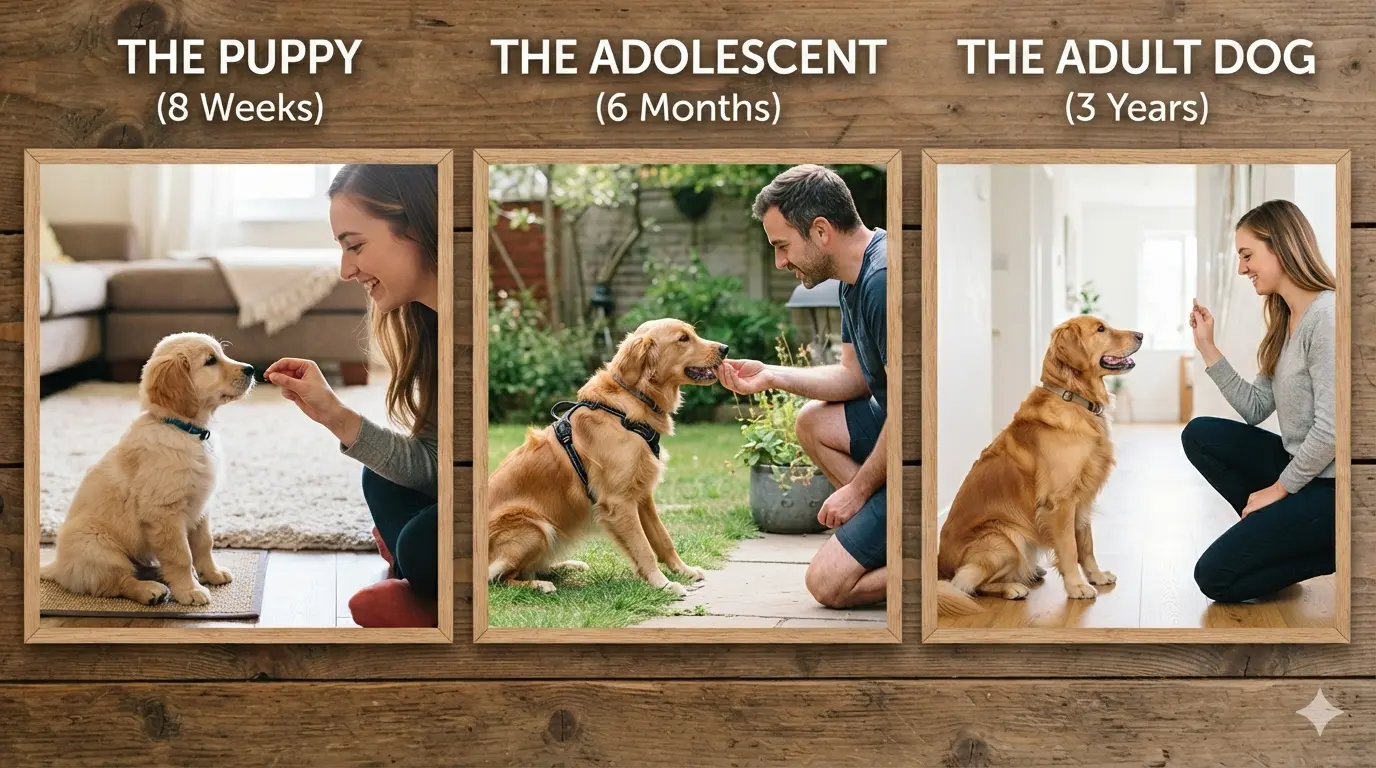
Our Dog Training guide covers the mechanics of positive reinforcement, but doesn’t get into how much those mechanics need to flex depending on a dog’s age. Tank’s “stubborn bulldog” phase, it turned out, lined up almost exactly with the adolescent window every trainer warns you about — which made a real difference in how I read what was actually happening versus what I initially assumed.
Understanding Dog Training by Life Stage: Why Age Changes the Approach
The reinforcement mechanism itself — reward immediately after a wanted behavior — doesn’t change across a dog’s life. What changes is attention span, impulse control, physical capability, and how much a dog’s brain and body can actually cooperate with what you’re asking. Training a puppy, an adolescent, an adult, and a senior dog “the same way” tends to produce frustration at every stage, not because the method is wrong, but because the expectations don’t match what’s realistic for that age — a training plan built around the wrong life stage sets everyone up to feel like something is broken when nothing actually is.
Puppies (8-16 Weeks): The Socialization Window
The period between roughly 3 and 16 weeks is when a puppy’s brain is most receptive to new experiences shaping their long-term comfort with people, animals, environments, and handling. The American Veterinary Society of Animal Behavior recommends starting socialization as early as 7 or 8 weeks and structured training classes before 3 months of age, rather than waiting until a puppy has completed a full vaccination series, since the socialization window closes faster than many owners expect.
A retrospective study on pre-adolescent training found that dogs who attended puppy training classes before 6 months of age showed reduced aggression, compulsive behavior, destructive behavior, and excessive barking as adults compared to dogs who hadn’t attended any classes — though the same study found no meaningful difference between starting before 4 months versus starting between 5 and 6 months, suggesting the “class before 6 months” window matters more than hitting an exact earlier date.
Vaccination timing is a common source of confusion here: many owners wait until a puppy has completed a full vaccination series before any group exposure, but most veterinary behaviorists now recommend beginning well-run puppy classes (with health screening and a clean facility) after the first round of vaccines rather than waiting for full completion, since the socialization window closes well before vaccines typically finish.
Practically, this stage is about short, frequent, low-pressure sessions — a few minutes at a time, multiple times a day — focused on basic cues, handling tolerance, and exposure to new experiences, not precision or duration.
Bite Inhibition and Handling Tolerance
Two skills matter more during this window than most owners initially prioritize: bite inhibition (teaching a puppy to control the force of their mouth during play, ideally before adult teeth come in) and handling tolerance (getting comfortable with paws, ears, mouth, and body being touched). Both are far easier to establish now than to retrofit onto an adult dog who’s never been taught either. Brief, positive handling sessions — a few seconds of ear or paw touching followed immediately by a treat — build tolerance gradually without overwhelming a young puppy.
Adolescents (6-24 Months): The “Regression” Owners Panic About
Adolescence is where a lot of owners conclude their dog has “forgotten” everything, or that training simply isn’t working anymore. According to veterinary behavior resources, this stage coincides with continued development of the prefrontal cortex — the brain region responsible for self-control and impulse regulation — meaning adolescent dogs are neurologically less equipped for the self-control tasks they may have handled fine as younger puppies, even though they’re bigger, stronger, and more physically capable.
This isn’t a sign training failed. It’s closer to a temporary capacity dip: the dog still “knows” the behavior, but has less built-in ability to override distraction, excitement, or impulse in the moment. Doubling down on consistency, keeping sessions short, and practicing previously “solid” behaviors in progressively more distracting environments tends to work better than assuming the dog needs to relearn everything from scratch.
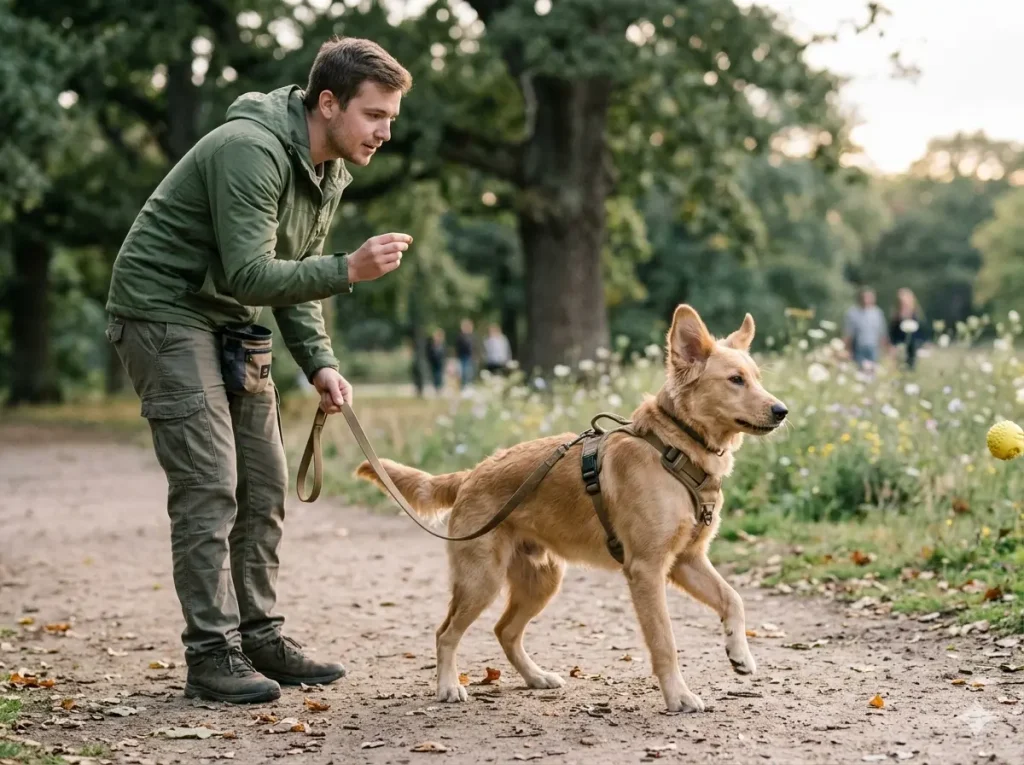
This stage also tends to coincide with a spike in exploratory chewing, boundary-testing, and selective hearing, which owners often misread as defiance. It’s less about a dog deciding to disobey and more about a still-developing brain being genuinely worse at resisting temptation than it will be in another year or so. Patience and structural management (baby gates, supervised freedom rather than full run of the house) tend to prevent more frustration during this window than trying to train the behavior away through sheer repetition alone.
Adults: Maintenance and Advanced Skills
Once a dog reaches full behavioral and physical maturity, training shifts from foundational work to maintenance and, for owners who want it, more advanced skills. Behaviors that were solid as a puppy or adolescent can still fade without occasional practice, so brief refresher sessions — even just a few minutes a week reinforcing core cues — tend to keep training durable long-term. This stage is also where our Dog Exercise by Life Stage guide and this one overlap most directly: a well-exercised adult dog is generally a more focused training subject than one who’s under-stimulated and restless.
Adult dogs are also the best candidates for expanding beyond basic obedience into more advanced or specialized skills — trick training, scent work, agility foundations, or simply more elaborate versions of cues they already know reliably. None of this is necessary, but for owners with a dog who’s mastered the basics and seems to want more mental engagement, this stage is when that kind of expansion tends to land best and stick most reliably.
Seniors: Cognitive Changes and Realistic Expectations
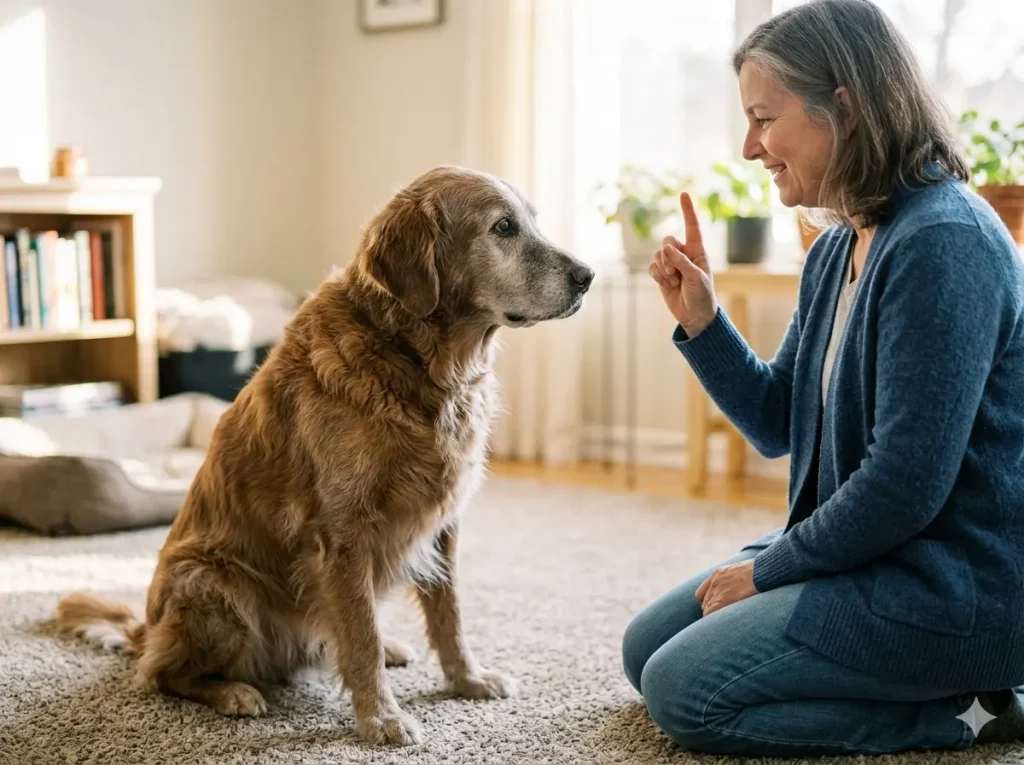
Senior dogs can absolutely still learn, but a few realistic adjustments help. Hearing or vision changes may mean a previously reliable verbal or visual cue needs re-pairing with a cue the dog can still perceive well. Cognitive decline, when present, can slow acquisition of brand-new behaviors, though most seniors retain well-established, long-practiced cues just fine. If a senior dog suddenly seems to “forget” something that’s been solid for years, that’s a pattern worth mentioning to a vet rather than assuming it’s simply old age — sudden changes are more often medical than purely behavioral.
Training also takes on a slightly different purpose for seniors: beyond obedience, short sessions double as mental stimulation and a way to keep a bond active even as physical activities become more limited. A senior dog who can no longer manage a long walk can often still enjoy and benefit from a five-minute nose-work game or a refresher on old tricks, which keeps engagement high without demanding much physically.
Breed and Individual Timing Variation
These windows are general guidelines, not fixed deadlines — individual dogs and breeds vary in how quickly they move through each stage. Our Brachycephalic Dog Care guide covers one specific variation worth knowing: heat sensitivity and reduced airway capacity mean short, cool-weather sessions matter more for flat-faced breeds at every life stage, not just as puppies or seniors. Large and giant breeds also tend to have an extended adolescent window that runs longer than the average timeline described above, which is worth factoring in before assuming a big dog “should” be past the teenage phase just because of their size.
Working and herding breeds bred for sustained mental engagement often show earlier trainability for complex tasks but can also hit a more pronounced adolescent testing phase, since the same drive that makes them quick learners also makes them more persistent about pushing boundaries. None of this means a specific breed’s timeline is fixed — it means breed tendencies are a reasonable starting expectation to adjust from, not a rule that overrides what a specific dog in front of you is actually showing.
Where This Fits Into Everything Else on Furrowise
This guide expands on the life-stage section of our Dog Training guide, and pairs with our Positive Reinforcement 101 guide for the underlying mechanics that apply at every stage described here. For the exercise side of the same life-stage framework, our Dog Exercise by Life Stage guide covers physical activity needs across the same age windows — reading the two together gives a fuller picture of how much a dog’s overall needs shift as they move from puppy to senior.
Editorial Note: This article draws on the AVSAB position statement on puppy socialization timing, a peer-reviewed retrospective study on pre-adolescent training outcomes, veterinary university guidance on adolescent brain development, and editorial analysis of that material. It is not based on hands-on testing of any product.
Disclaimer: This article is not veterinary or professional behavioral advice. If your dog shows a sudden loss of previously reliable behavior, or any concerning behavior change, please consult a vet or a certified professional trainer/behaviorist.