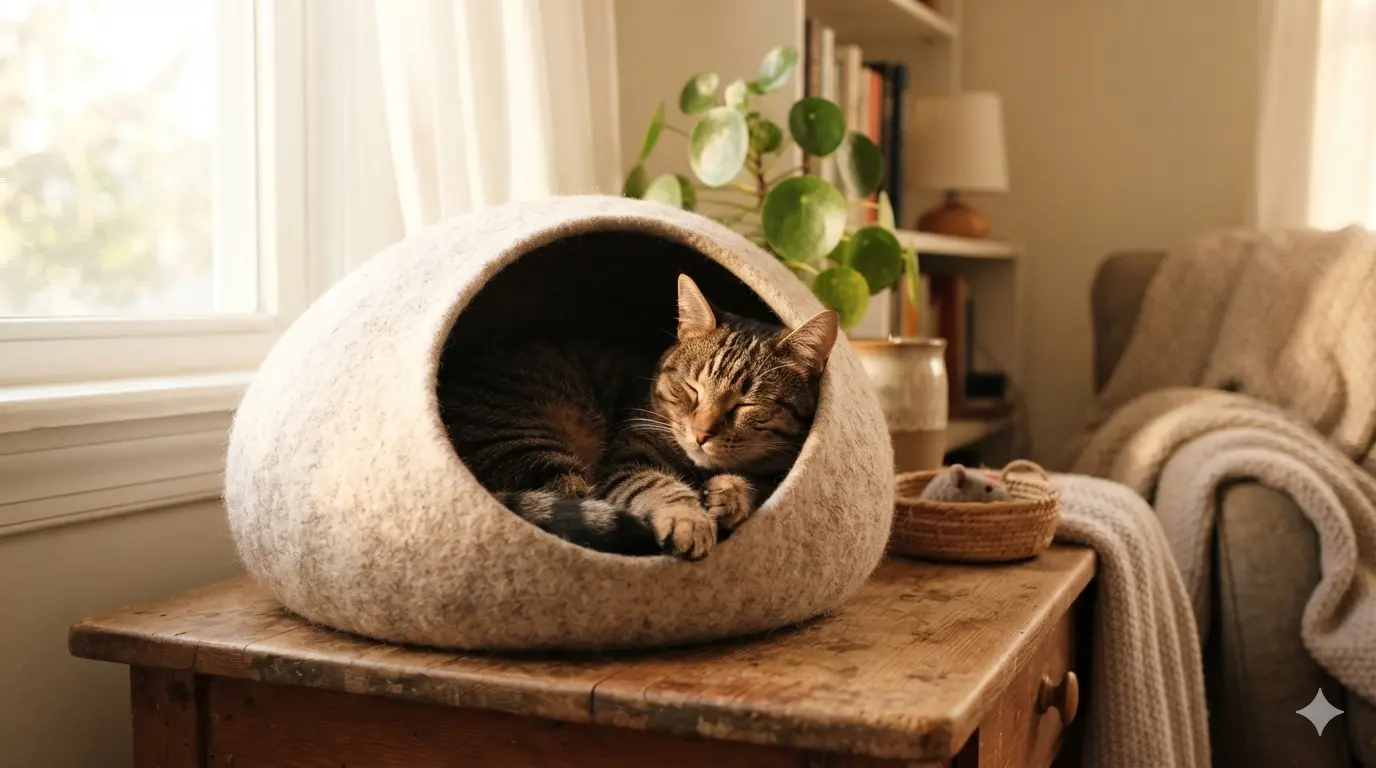
Our Cat Lifestyle Needs guide covers “a safe place” as one of the five pillars cats need, but doesn’t get into the practical setup. This guide does — what the research actually says about hiding spots, why vertical space does double duty as rest space for Moose specifically, and where a rest spot in the wrong location just gets ignored no matter how nice the bed itself is. None of this needs to be expensive; it mostly comes down to matching the space to what a cat actually wants rather than what looks good in the room.
Understanding Why a Dedicated Rest Space for Your Cat Matters
Cats sleep roughly 12-16 hours a day on average, more than most other companion animals, which makes where and how well that happens a meaningful part of their overall wellbeing rather than an afterthought. A randomized controlled trial on shelter cats found that cats given access to a hiding box showed a significantly faster decrease in stress scores than cats without one, reaching a lower, more stable stress level about a week earlier. Shelter cats face more acute stress than a settled house cat, but the underlying preference the study points to — a cat’s need for a retreat option — applies just as much at home, particularly for naturally shy cats, cats adjusting to a new environment, or multi-pet households where retreat options matter more than owners typically account for.
Hiding Spots and the Research Behind Them
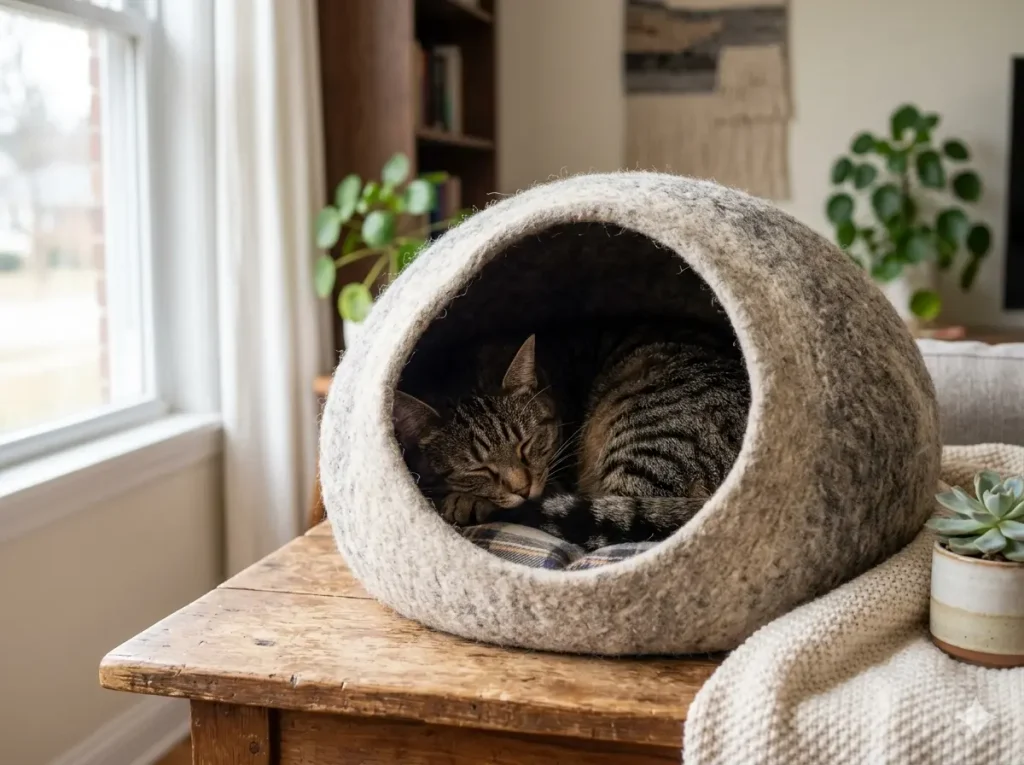
The research on hiding boxes specifically supports something simple: cats don’t need an elaborate rest space, they need an available option to remove themselves from a stressful or overstimulating situation. A covered bed, a cardboard box, an enclosed cat cave, or even a paper bag with the handles removed can serve this function — the research doesn’t point to any specific premium product outperforming a basic enclosed option, just that having some enclosed retreat available beats having none.
That said, a cat doesn’t necessarily want a fully enclosed space at all times. Many cats prefer something in between — partially enclosed, with a view of the room, rather than a completely sealed box. Offering a mix of fully enclosed and partially enclosed rest options tends to cover more of an individual cat’s actual preference than committing to just one style.
How Many Hiding Spots Is Enough
There’s no single validated number, but a reasonable starting point mirrors the general guidance for litter boxes and feeding stations in multi-cat households: at least one hiding-style rest spot per cat, located in different areas of the home rather than clustered together. For a single-cat household, having more than one option — one upstairs, one downstairs, or one in a quiet bedroom and one near a favorite window — gives a cat flexibility to choose based on time of day, temperature, or mood, rather than being limited to a single fixed spot.
Vertical vs. Ground-Level Rest Spaces
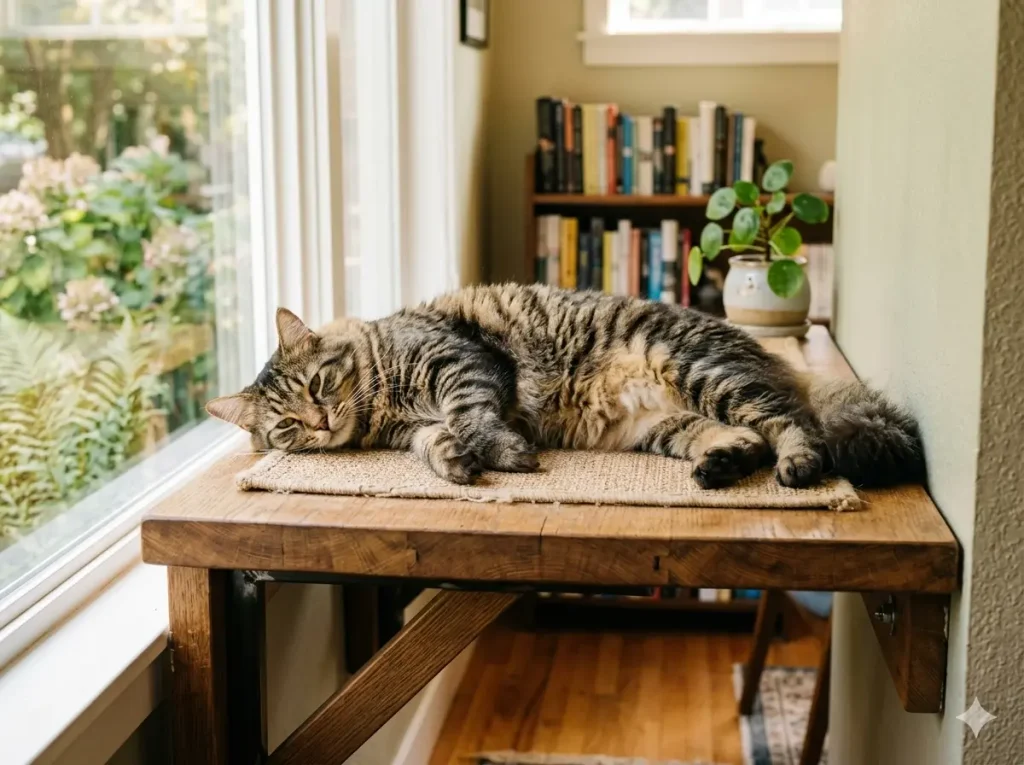
Our Cat Enrichment Toys Buying Guide covers vertical space as an enrichment category, but it does double duty as rest space too — a cat resting on an elevated perch is both resting and maintaining the territorial vantage point that seems to matter to feline security more broadly. Ground-level rest spaces (beds, covered caves) and elevated ones (shelves, cat trees, window perches) serve slightly different needs: elevated spots tend to satisfy a cat’s preference for surveying territory, while ground-level enclosed spots satisfy the retreat-and-hide function the research above points to. Offering both, rather than assuming one covers the other, tends to give a cat more genuine choice.
Placement Matters More Than Most Owners Expect
A rest space in a high-traffic area — a busy hallway, next to a loud appliance, near a door pets and people constantly pass through — tends to go unused regardless of how comfortable the bed itself is. Quiet corners, especially ones slightly elevated or tucked against a wall (giving a cat’s back some protection while they rest), tend to get chosen far more consistently. Temperature and light also matter: a sunny window perch is genuinely popular with most cats for daytime napping, but a rest space that gets uncomfortably hot in the afternoon sun may need a shaded alternative for the rest of the day.
Noise is worth considering separately from foot traffic. A rest space near a washing machine, a furnace, or a frequently used door can be quiet in terms of people passing by but still disruptive enough in sound that a cat avoids it. Testing a candidate spot at different times of day — including whenever household appliances typically run — helps catch this kind of issue before assuming a location simply “isn’t working” for other reasons.
Multi-Cat Households and Rest Space
Cats in multi-cat households need enough separate rest spaces that no cat has to compete for one, following the same “separated resources” principle that applies to litter boxes and feeding stations. A single shared bed, no matter how large, doesn’t function the same way as multiple distinct rest options spread through the home — a cat who’s lower in the household hierarchy may simply avoid resting near a more confident cat if the only good spot is a shared one. Providing rest spaces on multiple levels and in multiple rooms tends to prevent the kind of quiet, easy-to-miss competition that shows up as one cat resting somewhere clearly less comfortable than it should be.
Watching where each cat actually chooses to rest over the first few weeks in a new setup reveals more than guessing upfront. If one cat consistently avoids a certain room or level of the house, that’s useful information about the household’s social dynamics — sometimes solved with more rest options in the avoided area, sometimes indicating a bigger territorial or personality mismatch worth addressing separately.
Rest Space Considerations for Large-Breed Cats
Our Cat Lifestyle Needs guide covers the joint considerations that come with being a large-breed cat, and rest space is part of that picture. Moose needs sturdier, wider platforms than an average-sized cat’s rest spots would require — a narrow shelf rated for a typical domestic shorthair doesn’t always hold up to a much larger cat’s full body weight and the impact of jumping up or down from it. Checking weight ratings on elevated rest furniture, rather than assuming “cat-sized” covers every cat, matters more for large breeds specifically.
This extends to enclosed beds too — a cave-style bed sized for an average cat can be genuinely too small for a Maine Coon to fully curl into, which defeats some of the retreat function a hiding spot is meant to provide. Sizing up rather than assuming a “large” label on a cat product actually fits a large-breed cat, and checking a specific bed’s interior dimensions rather than relying on the packaging alone, avoids buying something that technically fits the description but not the cat.
Signs the Setup Isn’t Working
A rest space that’s consistently ignored, a cat who seems to hide in unusual or clearly less comfortable spots (behind furniture, inside closets) instead of using the beds provided, or a cat who seems restless and unable to settle anywhere are all signs the current setup isn’t meeting the cat’s actual needs. Sudden new hiding behavior, especially if it comes with other changes like reduced eating or litter box avoidance, is worth a vet visit rather than an assumption that it’s purely a preference issue.
It’s also worth distinguishing normal hiding from concerning hiding. A cat who retreats to a favorite hiding spot during a loud thunderstorm or when guests visit, then resumes normal behavior once the disruption passes, is using the space exactly as intended. A cat who’s begun hiding constantly, avoiding normal interaction, and showing other signs of withdrawal represents a different pattern that calls for closer attention rather than simply providing more hiding options.
Where This Fits Into Everything Else on Furrowise
This guide expands on the “safe place” pillar covered in our Cat Lifestyle Needs pillar page, and connects to our Cat Enrichment Toys Buying Guide for the vertical space and cat tree side of the equation, and our Cat Exercise by Life Stage guide for how rest and activity balance across a cat’s life.
Editorial Note: This article draws on a peer-reviewed randomized controlled trial on hiding boxes and shelter cat stress, the AAFP/ISFM Feline Environmental Needs Guidelines referenced in our Cat Lifestyle Needs guide, and editorial analysis of that material. Details about Moose’s rest space needs reflect his real day-to-day routine as Maddie’s own cat — not hands-on testing of any product.
Disclaimer: This article is not veterinary advice. If your cat shows new hiding behavior alongside other changes like reduced eating or litter box avoidance, please consult a vet.