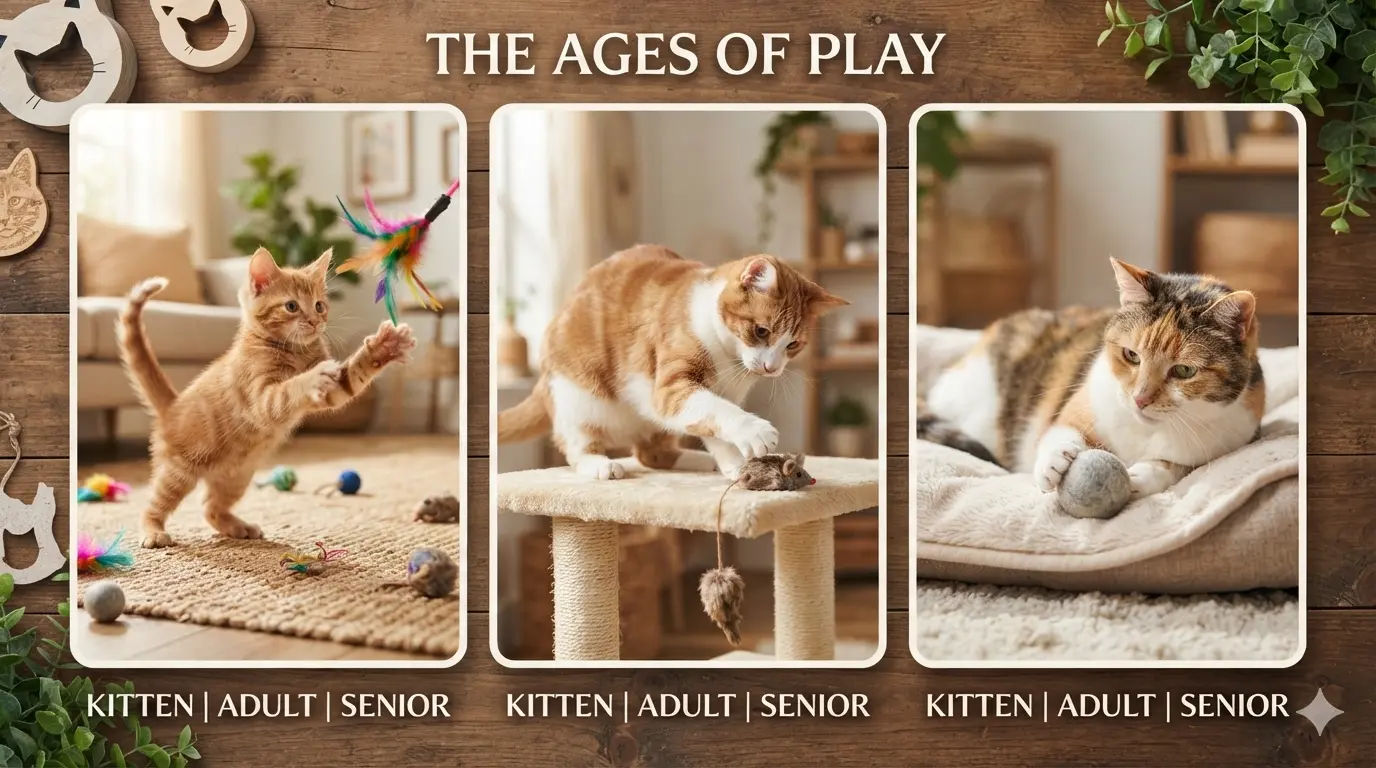
Our Cat Lifestyle Needs guide covers play and exercise as one piece of a bigger picture, but it’s worth breaking out on its own — because a kitten, a healthy adult, and a senior cat managing early joint changes need genuinely different things from playtime. Moose has made the senior-adjacent version of this personal territory earlier than expected: as a large-breed cat, the joint considerations we cover in our Cat Lifestyle Needs guide mean thinking about exercise type, not just amount, matters more for him than for an average-sized cat his age. This guide breaks down what actually changes at each stage, and what to watch for when something looks off.
Understanding Cat Exercise by Life Stage: Play Is Exercise for Cats
Cats don’t need walks the way dogs do, but that doesn’t mean exercise needs are simple or constant across a cat’s life. Play is exercise for cats — it’s how most of their physical activity happens indoors, and it does double duty as the predatory outlet cats need regardless of age. What changes across life stages isn’t whether play matters, but how much intensity a cat’s body can handle and what kind of play actually satisfies them at each stage.
Kittens: High-Intensity Play and Development
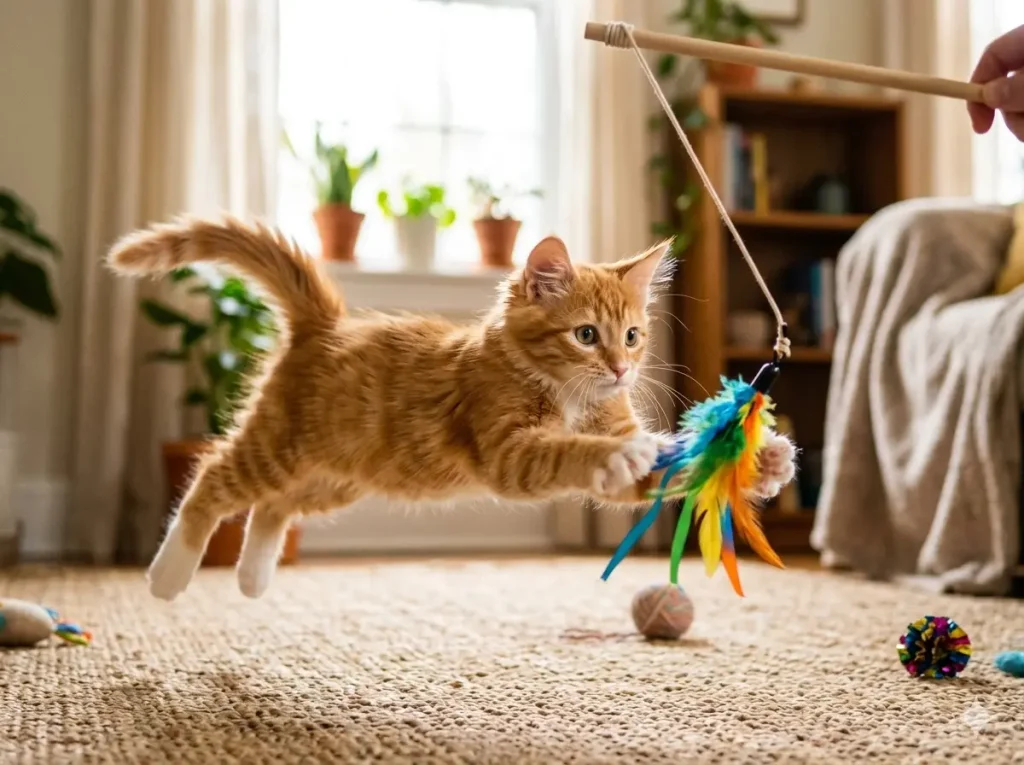
Kitten play isn’t optional downtime — it’s actively building coordination, social skills, and hunting ability. According to veterinary behavior resources, locomotor play (climbing, jumping, general physical activity) is fully developed by 10 to 12 weeks of age, while object-focused play — batting, pouncing, and “capturing” toys — ramps up around the same window as kittens shift attention from littermates to prey-like objects. A large peer-reviewed review of cat play research notes that this object play incorporates real prey-handling sequences (poking, scooping, leaping, grasping, biting), meaning a kitten swatting a toy across the floor is practicing genuine hunting mechanics, not just burning energy. The same review also highlights how inconsistently cat play has been defined and measured across decades of research, which is part of why so much popular advice about kitten play is based on general observation rather than tightly controlled studies — worth keeping in mind as a limitation, even where the broad recommendations hold up well in practice.
Practically, this means kittens generally want and need frequent, intense, short bursts of play — multiple sessions a day rather than one long one — using toys that let them fully act out chase-and-catch, not just chase. Trying to calm a kitten down by ignoring their play drive tends to backfire; redirecting that energy into structured sessions works better than suppression. Kittens raised alongside littermates or another playful cat often self-regulate some of this through social play, but a single kitten in a household typically needs an owner to fill that role more actively, since there’s no other cat available to absorb the excess energy naturally.
Adults: Preventing the Indoor Cat Weight Gain Trap
Adult cats, especially indoor-only ones, are prone to a specific trap: exercise needs don’t disappear at maturity, but the obvious cues that a kitten is under-exercised (destructive energy, constant zoomies) become quieter and easier to miss in a calmer adult cat. An adult cat who simply isn’t very active isn’t necessarily “just chill” — sustained low activity combined with free access to food is one of the more common contributors to indoor cat weight gain, which itself is linked to a range of downstream health issues.
Two or three short, focused play sessions a day — a wand toy or similar predatory-style play — tends to do more for an adult cat’s activity level than leaving toys out and hoping self-directed play fills the gap. Our Cat Enrichment Toys Buying Guide covers specific product categories that make structured play easier to build into a daily routine.
The timing of play sessions matters too, not just the frequency. Many cats have natural activity peaks around dawn and dusk, tied to their evolutionary hunting patterns — scheduling at least one play session during one of these windows tends to get more genuine engagement than the same toy offered in the middle of a cat’s typical nap period. This is also a practical tool for owners dealing with early-morning wake-ups: a vigorous play session before bed can help some cats sleep more soundly through the night instead of demanding attention at 5 a.m.
Seniors: Managing Mobility Changes
Senior cat exercise needs shift significantly, and the shift is easier to miss than in dogs because cats hide joint pain unusually well. One veterinary source cites a study finding that 90% of cats over 12 years old show radiographic evidence of osteoarthritis in at least one joint — and most of those cats showed no clinical signs recognized by their owners or even noted in medical records. That gap between what’s actually happening in the joints and what’s visibly obvious is the core challenge with senior cat activity: a cat who’s simply jumping less, grooming less thoroughly, or avoiding a favorite high perch may be managing joint pain quietly rather than just “slowing down with age.”
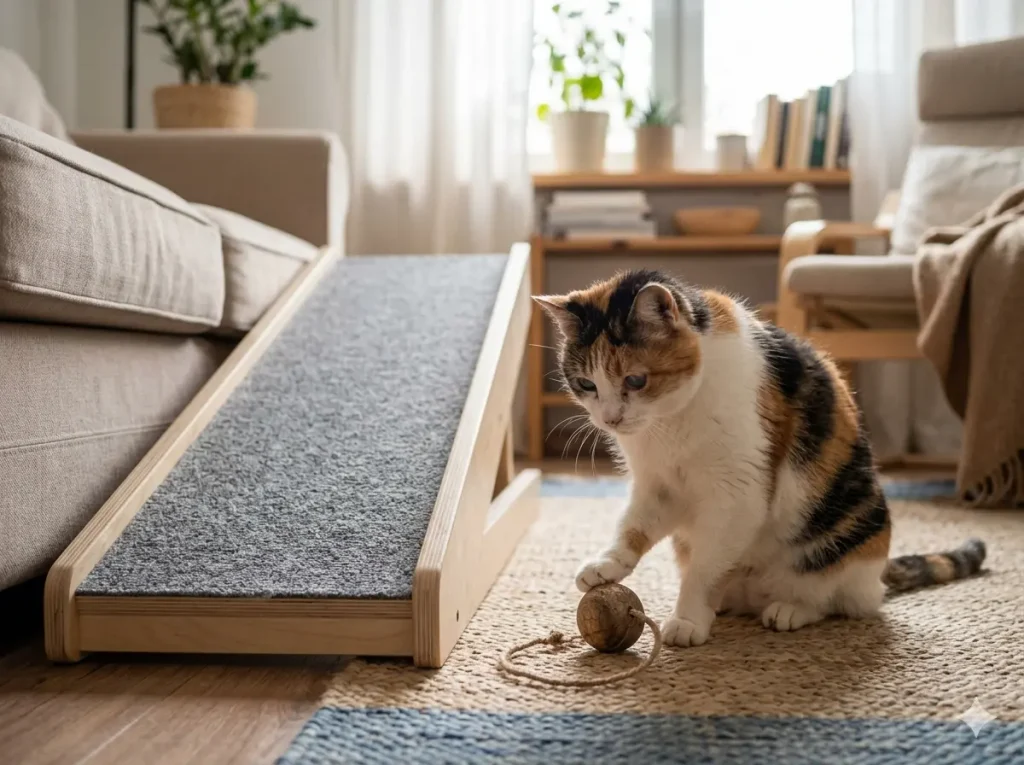
Adjustments that tend to help: lower-height perches and ramps to reduce the need for big jumps, shorter and gentler play sessions rather than high-intensity chase games, and floor-level toys instead of ones that encourage leaping. Any noticeable drop in a senior cat’s activity or mobility is worth a vet visit rather than an assumption that it’s simply old age.
Weight management becomes especially important for senior cats managing joint changes, since extra body weight adds direct load to joints that are already compromised. A vet can help determine whether a senior cat’s current weight is appropriate and whether any dietary adjustment should accompany the exercise changes — this is one area where nutrition and exercise genuinely intersect rather than operating as separate concerns worth managing in isolation from each other.
Breed and Body Type Considerations
Exercise needs shift with body type as much as with age. Large-breed cats like Moose carry more mass through their joints during any jump or landing, which is part of why our Cat Lifestyle Needs guide flags joint considerations as a large-breed-specific issue rather than a universal one. Practically, that’s meant favoring floor-level and low-jump play for Moose over the high-leap games that work fine for an average-sized cat the same age — a wand toy kept low to the ground gets just as much genuine engagement from him as one waved overhead, without the repeated hard landings. Flat-faced cat breeds (Persians, Exotic Shorthairs) bring their own version of this, with heat and breathing considerations similar to what our Brachycephalic Dog Care guide covers for dogs — shorter, cooler-weather play sessions tend to suit them better than sustained high-intensity chasing.
Signs You’re Under- or Over-Doing It
A few signals apply at any life stage: a cat who seems restless, vocal, or destructive may be under-stimulated regardless of age; a cat who’s reluctant to continue a play session, breathing hard afterward, or notably stiff the following day may be getting more than their body currently wants. Neither extreme is something to push through — scaling activity type and intensity to what a specific cat’s body and enthusiasm actually show tends to work better than sticking to a fixed routine regardless of how the cat is responding on a given day.
Multi-Cat Households and Exercise
Cats in multi-cat households don’t automatically exercise each other, even though it’s a common assumption. Some cat pairs do genuinely play together and keep each other active, but others coexist without much interaction at all, or — worse — one cat may be too intimidated by another to engage in normal play in shared spaces. Watching whether play between resident cats actually looks mutual and relaxed (not one-sided chasing that ends in hiding) matters more than assuming multiple cats means built-in exercise coverage. Providing separate play opportunities per cat, rather than relying entirely on cat-to-cat interaction, tends to be the safer default.
Where This Fits Into Everything Else on Furrowise
This guide expands on the exercise section of our Cat Lifestyle Needs pillar page, and pairs with our Cat Enrichment Toys Buying Guide for the products that make structured play practical, and our Cat Training guide for the mental-exercise side of the equation. For multi-pet households managing both a dog and a cat’s exercise needs, our Dog Exercise by Life Stage guide covers the same framework from the dog side.
Editorial Note: This article draws on veterinary behavior resources on kitten play development, a peer-reviewed review of cat play research, and published veterinary data on feline osteoarthritis prevalence, alongside editorial analysis of that material. Details about Moose’s exercise adjustments reflect his real day-to-day routine as Maddie’s own cat — not hands-on testing of any product.
Disclaimer: This article is not veterinary advice. If your cat shows a sudden drop in activity, reluctance to jump, or other mobility changes, please consult a vet.