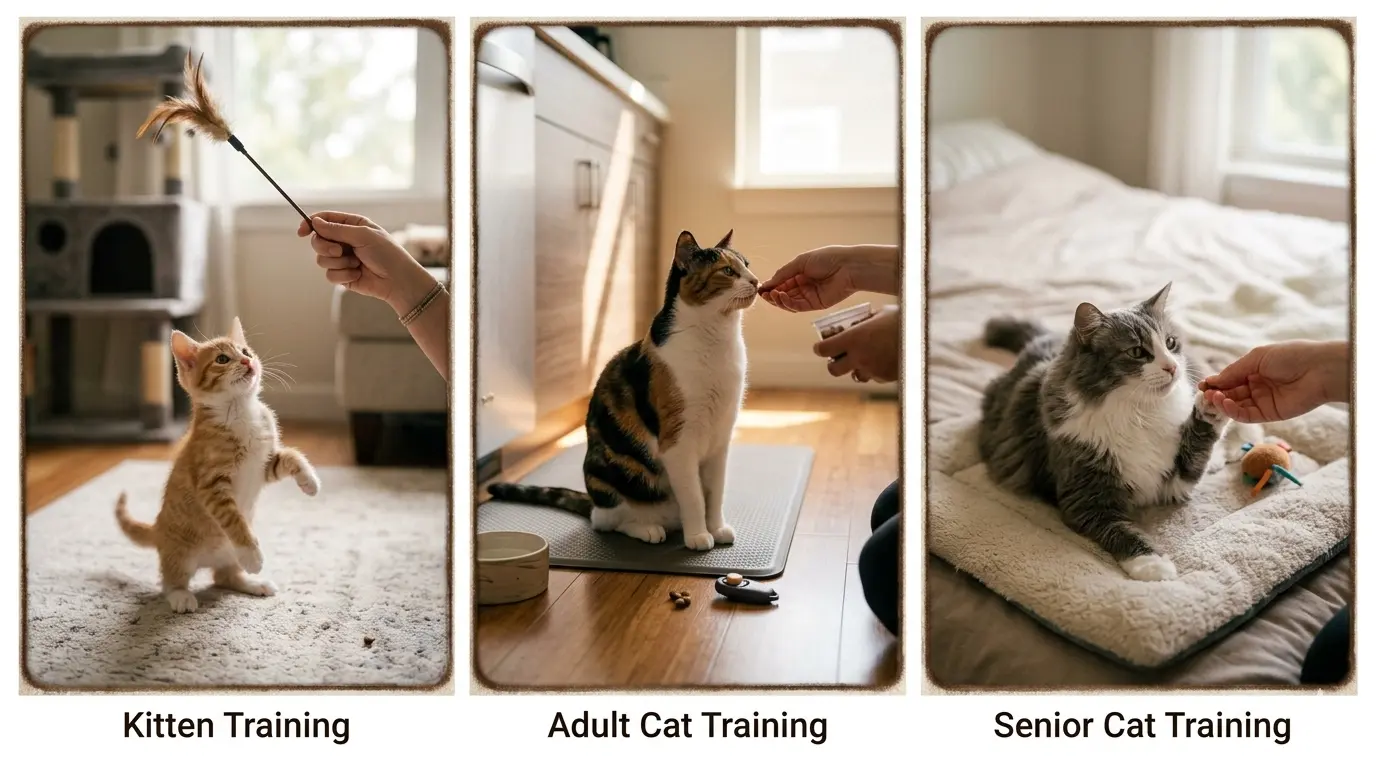
Our Cat Training guide covers the mechanics of reward-based training, but doesn’t get into how much a cat’s age shifts what’s realistic. Moose learned to target-touch and walk on a harness readily as a young adult; teaching him anything new now, in his more settled years, takes longer and more patience — not because something’s wrong, but because that’s a normal part of how training shifts across a cat’s life. This guide walks through what realistically changes at each stage, and what to adjust when a training plan that worked before suddenly stops working as well.
Understanding Cat Training by Life Stage: Why Age Changes the Approach
The underlying mechanism — reward immediately after a wanted behavior — stays the same at every age. What changes is attention span, motivation, physical capability, and how much a cat’s brain and body can engage with a session on a given day. Expecting a kitten, an adult, and a senior cat to progress at the same pace tends to create frustration that has nothing to do with whether the method itself is working — a training plan built around the wrong life stage makes it easy to conclude that a cat is “untrainable” when the real issue is a mismatch between the expectations and what’s realistic for that age.
Kittens: The Learning Window
Kittens are in an active developmental window where play, object investigation, and early handling experiences shape long-term comfort with people and novel situations. A peer-reviewed review of cat play research notes that object-focused play — the same behavior that makes kittens such enthusiastic training subjects — incorporates real prey-handling sequences, meaning training that channels this instinct (target-touching, chasing a lure toward a desired position) tends to click faster during this window than it will later in life.
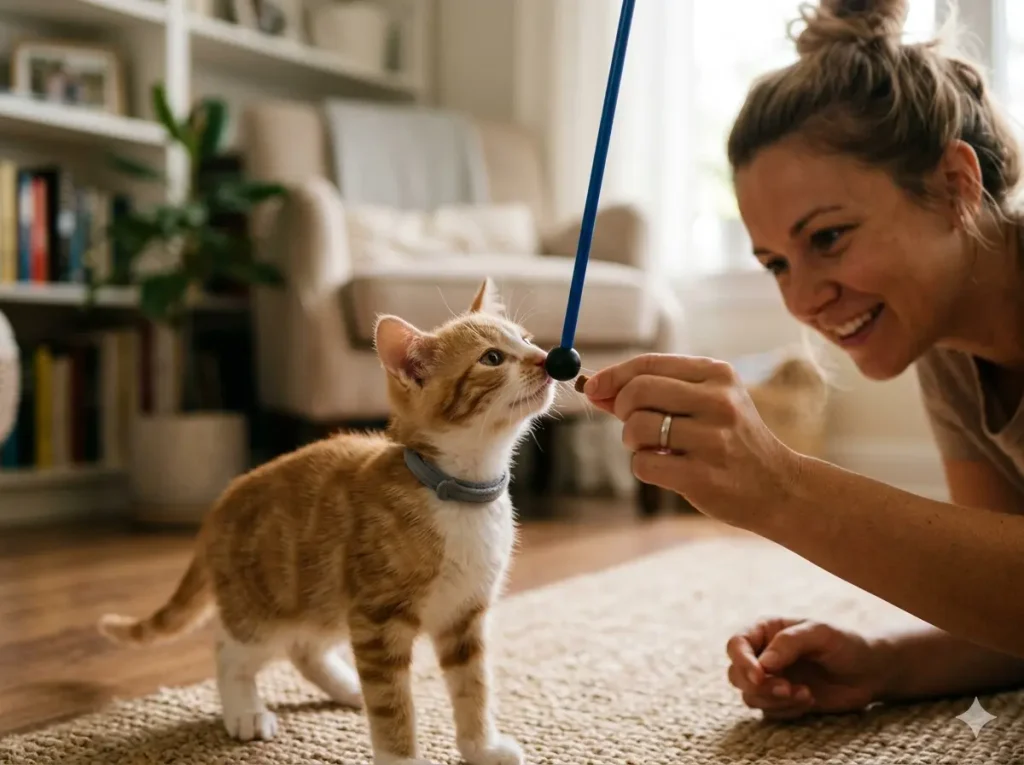
Food motivation in kittens is generally high and easy to work with, since growing kittens are usually hungry and eager. That makes this a particularly good time to establish that training sessions are a reliable source of good things — a positive association that tends to carry forward, making an adult cat more willing to engage with training even when their baseline food drive is lower than it was as a growing kitten.
Short, frequent sessions work best here, same as with kittens’ natural play patterns — a few minutes at a time, multiple times a day, rather than one longer session. Building positive handling tolerance (getting comfortable with paws, ears, and body being touched) during this window pays off for years of easier vet visits, grooming, and general handling later.
Socialization Overlaps With Training
Kitten training and kitten socialization happen on largely the same timeline, and the two reinforce each other more than owners often realize. A kitten who’s being gently, positively introduced to handling, new sounds, and novel objects during training sessions is also building general confidence that carries into every other part of life — a well-socialized kitten tends to be a more relaxed, engaged training subject as an adult, and the reverse holds too, where consistent positive training sessions become one of the socialization experiences themselves.
Adults: Building on What’s Already There
Adult cats can learn new behaviors just as reliably as kittens — the “old cats can’t learn new tricks” framing doesn’t hold up for cats any more than it does for dogs. What typically changes is motivation and established habits rather than raw capacity to learn. An adult cat with no prior training history may simply need more sessions to build the same foundational understanding a kitten picks up faster, not because they’re less capable, but because they’re starting from a different baseline. Patience with that slower start tends to matter more than switching methods, since the mechanism itself works the same way at any age.
This stage is also where more specific goals tend to come into focus — harness walking, recall, or specific behavior redirection (scratching post use, for example) rather than general foundational work. Our Cat Training guide covers these common goals in more depth.
Consistency across the household matters more for adult cats than owners often expect, since an adult cat has usually had more time to develop habits around inconsistent handling than a kitten would have. If one household member reinforces jumping on counters with attention while another discourages it, an adult cat is likely to have a more entrenched version of that mixed-signal confusion than a kitten just starting to form habits — making consistency an even higher priority at this stage.
Environment matters too. Adult cats are often more territorial and routine-dependent than kittens, so introducing training in a familiar, quiet part of the home tends to work better than trying it somewhere new or busy. Once a behavior is reliable in a comfortable spot, gradually practicing it in slightly less familiar rooms helps it generalize without overwhelming a cat who’s more sensitive to change than a young kitten would be.
Seniors: Cognitive Changes and Realistic Expectations
Senior cats can still train well, but cognitive changes become a real factor to account for. According to veterinary research cited by clinical sources, roughly 28% of cats between 11 and 14 years old develop at least one behavior consistent with cognitive dysfunction, rising to about 50% of cats over 15. This doesn’t mean training stops working — it means a previously reliable senior cat who suddenly seems slower to respond, confused by a well-known cue, or less engaged than usual is showing a pattern worth mentioning to a vet, not just chalking up to “getting old.”
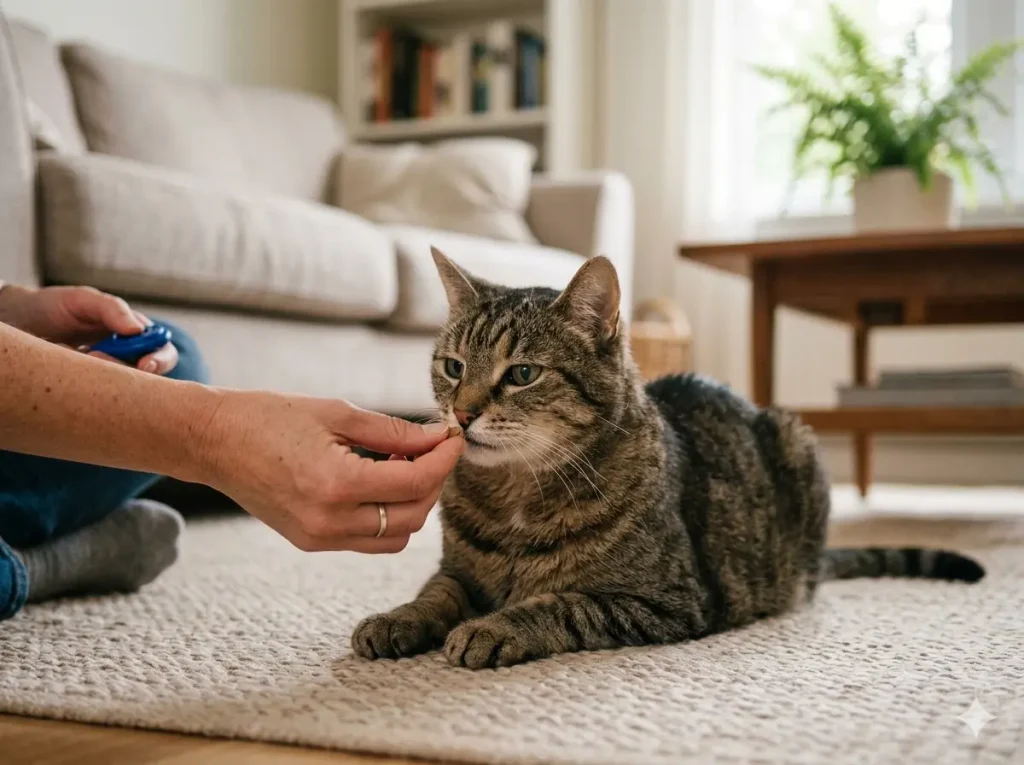
For senior cats without diagnosed cognitive changes, training still works largely the same way it always has, just often with shorter sessions matched to whatever energy and focus the cat has that day. Training also doubles as valuable mental stimulation for a senior cat whose physical activity may be more limited than it once was. A short, gentle session — a few rewarded target touches, a refresher on an old favorite trick — keeps a senior cat’s mind engaged without demanding much physically, and often strengthens the bond between cat and owner at a stage of life when that connection matters more than ever.
Sensory changes are worth watching for too. A senior cat with declining hearing may stop responding to a verbal cue not because they’ve forgotten it, but because they genuinely can’t hear it as well anymore — switching to a hand signal or a more distinct sound can restore a “lost” behavior instantly once the actual cause is identified. Declining vision similarly can make a visual cue harder to pick up from across a room, which is easy to misread as disinterest rather than a straightforward sensory limitation.
Breed and Individual Timing Variation
These stages are general patterns, not fixed rules — individual cats vary in how quickly they move through them. Our Cat Lifestyle Needs guide covers joint considerations for large-breed cats like Moose, and training is a place those considerations show up too: physical cues that require jumping or extended reaching may need adapting for a cat whose joints carry more mass, regardless of what life stage they’re technically in. A cat’s individual temperament — naturally food-motivated and eager versus more independent and slower to engage — often matters more than age alone in predicting how quickly a specific cat progresses.
Early life experiences also shape how a cat responds to training well into adulthood and beyond. A cat with a well-socialized kittenhood generally approaches new training challenges with more confidence than a cat who came from a less enriched early environment, even if both cats are the same age and breed now. This isn’t a reason to give up on training an under-socialized adult or senior cat — it just means expecting a slower build of confidence and trust before training progress really takes off, rather than assuming something is uniquely wrong with that specific cat.
Where This Fits Into Everything Else on Furrowise
This guide expands on the life-stage considerations touched on in our Cat Training guide, and pairs with our Positive Reinforcement 101 for Cats guide for the underlying mechanics that apply at every stage described here. For the exercise side of the same life-stage framework, our Cat Exercise by Life Stage guide covers physical activity needs across the same age windows — reading the two together gives a fuller picture of how much a cat’s overall needs shift as they move from kitten to senior, and how training and exercise routines can be built to complement each other rather than compete for the same limited energy.
Editorial Note: This article draws on a peer-reviewed review of cat play research, published veterinary data on feline cognitive dysfunction prevalence, and editorial analysis of that material. It is not based on hands-on testing of any product.
Disclaimer: This article is not veterinary or professional behavioral advice. If your cat shows sudden confusion, disorientation, or a significant change in previously reliable behavior, please consult a vet.