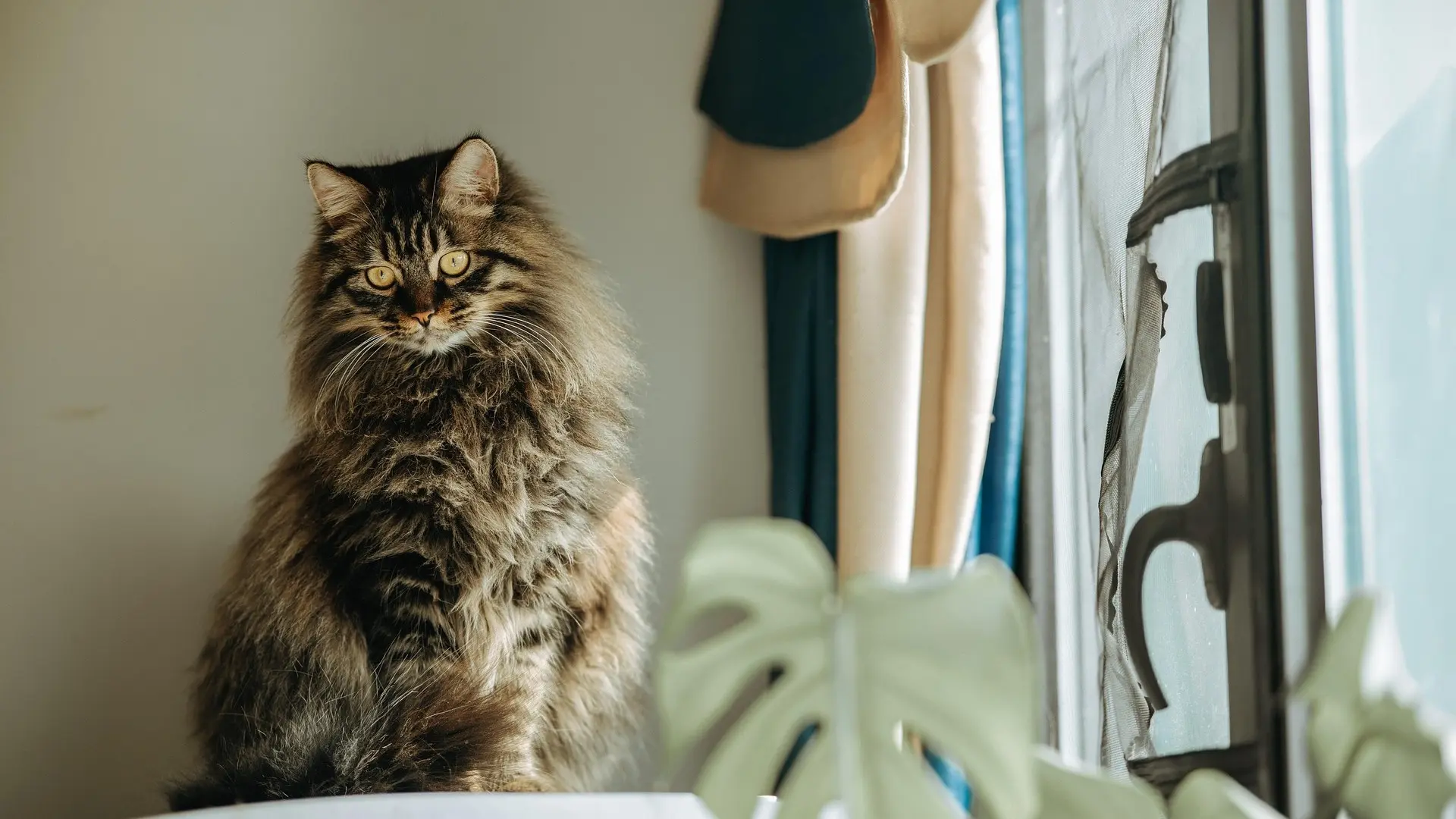
My Maine Coon took almost four years to actually look like the cat on the breed posters. For most of that time he was this oddly long, gangly teenager with paws that seemed to belong to a bigger cat than the one attached to them. He also came with a coat that mats if I skip brushing for more than a few days, and — like a lot of Maine Coons — a heart condition risk I now screen for every year at the vet. None of that is about what’s in his bowl. This guide is the starting point for everything we’ll cover under “Lifestyle” here on Furrowise — play, environmental enrichment, rest, grooming, safety, and the daily-life decisions that add up to a cat who’s actually thriving.
Understanding Cat Lifestyle Needs Beyond the Food Bowl
The most widely cited framework for this comes from the American Association of Feline Practitioners (AAFP) and the International Society of Feline Medicine (ISFM), whose peer-reviewed Feline Environmental Needs Guidelines organize a cat’s wellbeing around five “pillars”: a safe place, multiple separated key resources, opportunities for play and predatory behavior, positive human contact, and an environment that respects a cat’s sense of smell. The guidelines note that addressing these needs isn’t optional extra credit — it’s treated as essential to a cat’s physical health and emotional wellbeing, not just a nice-to-have.
In practice, this means a cat who’s scratching furniture, avoiding the litter box, or seems constantly on edge isn’t necessarily being “difficult.” There’s a reasonable chance one of these five pillars isn’t being met, and food alone was never going to fix that.
Play and Exercise Needs by Life Stage
Cats don’t need daily walks the way dogs do, but understanding exercise needs by life stage still matters for keeping a cat physically and mentally healthy.
Kittens are usually a blur of short, intense play bursts followed by long naps — their coordination and hunting-style behaviors (stalking, pouncing, batting) develop through this play, so it’s less about “tiring them out” and more about letting that instinct run its course safely.
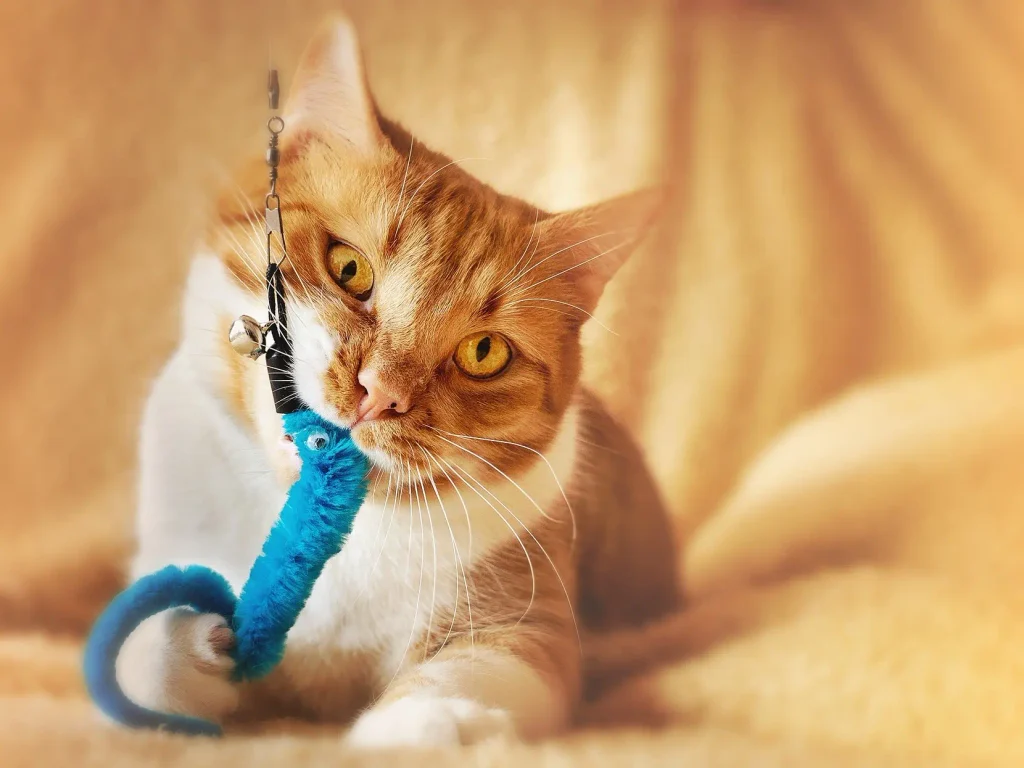
Adult cats generally do well with a couple of short, focused play sessions a day that mimic a hunt — a wand toy or laser pointer followed by a physical toy they can actually catch and “kill” tends to satisfy the full predatory sequence better than a laser alone.
Senior cats often still want to play, just in shorter bursts and lower-impact ways; a sudden drop in play interest is worth mentioning to your vet rather than assuming it’s just personality or old age.
Moose’s case adds another layer: as a large-breed cat, his joints carry more mass than an average domestic shorthair’s, and large-breed cats are generally considered more prone to joint strain if allowed to get overweight, similar to what’s seen in large dog breeds. Keeping play sessions frequent but low-impact — floor-level toys rather than encouraging big jumps — became more of a priority for him than for an average-sized cat.
Environmental Enrichment Ideas
A cat’s environment does a lot of the behavioral heavy lifting that toys alone can’t. A few simple environmental enrichment ideas cover most of what the five-pillars framework calls for:
- Vertical space — cat trees, shelves, or window perches that let a cat survey their territory from up high
- Scratching surfaces in more than one location and orientation (vertical posts and horizontal pads both get used differently)
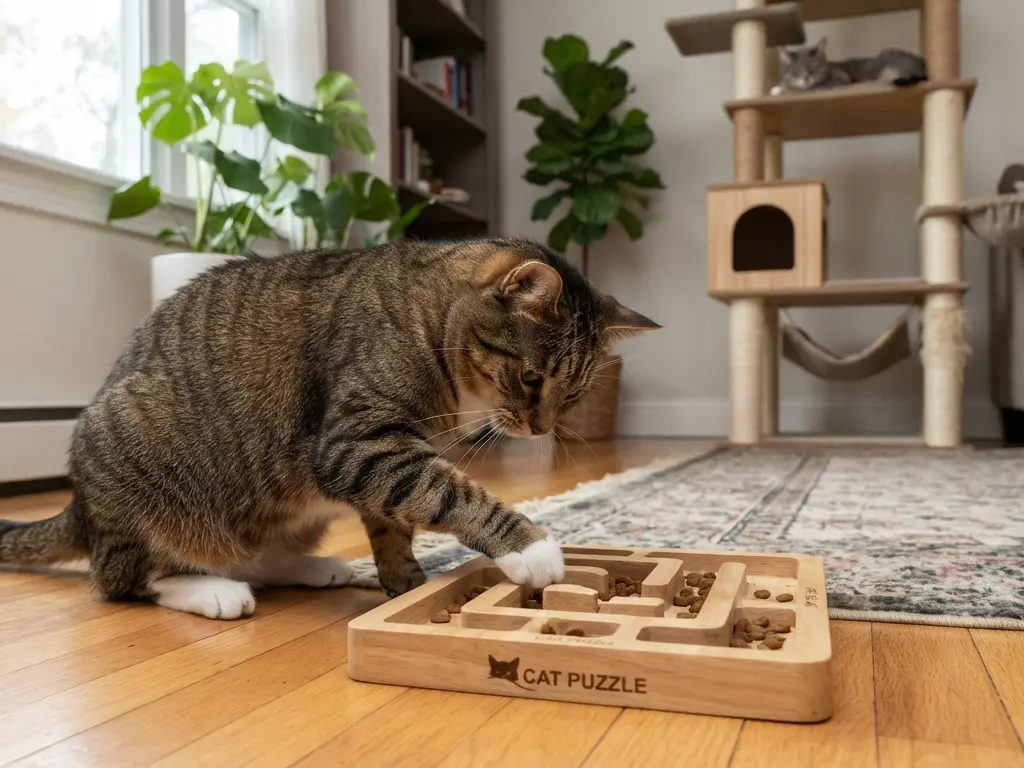
- Food puzzles or scatter-feeding, which taps into natural foraging behavior instead of a flat bowl
- Rotating a small set of toys rather than leaving everything out permanently, so nothing goes stale from overexposure
None of this needs to be elaborate. The goal is giving a cat’s senses and instincts something to actually do during the day.
Rest Is Part of the Job, Not a Sign of Laziness
Cats sleep a lot by nature, but where they rest matters as much as how long. A predictable rest space setup — a covered bed, a high shelf, a quiet corner they’ve claimed as their own — that isn’t constantly disturbed by household traffic or other pets directly supports the “safe place” pillar from the guidelines above.
For Moose, rest also intersects with his breed’s cardiac risk. Maine Coons are disproportionately affected by hypertrophic cardiomyopathy (HCM), a heart-muscle thickening condition linked to a specific genetic mutation found at meaningfully higher rates in the breed than in cats generally, according to published veterinary research. HCM often has no obvious symptoms early on, which is exactly why annual veterinary heart screening — not just watching for visible symptoms at home — matters more for this breed than for an average shorthair. If you ever notice rapid or labored breathing, lethargy, or reduced appetite in a Maine Coon or Maine Coon mix, that combination should be treated as urgent and checked by a vet promptly rather than monitored at home.
Grooming: A Daily Part of Cat Lifestyle Needs, Not a Chore You Can Skip
Long-haired large breeds like Maine Coons need grooming built into the weekly routine, not handled reactively once mats appear. Moose gets brushed several times a week, with extra attention around his hind legs, belly, and the “britches” area where mats form fastest. Skipping even a few sessions in a row is usually when I notice tangles starting.
This isn’t purely cosmetic — mats pull on skin, can trap moisture and debris against it, and in neglected cases can restrict movement or hide skin problems underneath. Regular grooming also happens to be a good excuse to run your hands over your cat’s body often enough to notice new lumps, sore spots, or weight changes early.
Positive Human Contact Cats Actually Want
The “positive human contact” pillar is easy to get backwards — a lot of owners either force interaction on a cat who wants space, or assume a standoffish cat just doesn’t like affection at all. In reality, cats tend to prefer contact that’s predictable and consent-based: they approach, they initiate, and the interaction stops when they walk away. Letting a cat choose when to be picked up, petted, or sat near tends to build more trust over time than initiating contact on a human schedule.
This matters especially for cats who came from shelters, multiple homes, or limited early socialization — trust often builds slowly through repeated low-pressure positive interactions rather than through a single dramatic bonding moment. Moose was fairly confident from kittenhood, which is common in well-socialized purebred lines, but it’s not a guarantee — individual temperament varies even within a breed known for being sociable.
Travel and Routine Disruptions
Cats are generally more routine-sensitive than dogs, and even small changes — a new litter brand, rearranged furniture, houseguests, or travel — can register as stress. Carrier training well before an actual trip (leaving the carrier out as a normal piece of furniture, not just something that appears before vet visits) makes travel meaningfully less stressful when it’s actually needed. Keeping feeding times and litter box locations as close to normal as possible during any disruption also helps more than people expect.
Cat-Proofing Your Home
A lifestyle-friendly home is a safe one. A few areas that come up constantly when cat-proofing your home:
- Securing string, ribbon, rubber bands, and similar linear items — these pose a real ingestion/obstruction risk that’s easy to underestimate
- Keeping certain human foods and plants out of reach (lilies are highly toxic to cats specifically, along with chocolate, onions/garlic, and xylitol-containing products)
- Screening windows securely, since cats can and do fall from heights they misjudge
- Covering or securing any small, chewable electrical cords
Multi-Pet Households Add Another Layer to Cat Lifestyle Needs
If you’re managing more than one cat, or a cat alongside dogs, lifestyle planning gets more complex — enough separated resources (litter boxes, food stations, resting spots) that no animal has to compete or feel cornered, and vertical space a cat can retreat to that a dog can’t follow into. We’ll go deeper on this in a dedicated multi-pet household guide.
When a Lifestyle Change Might Actually Be a Health Issue
A genuine shift in behavior — new hiding, sudden aggression, a normally social cat avoiding contact, or changes in litter box habits — isn’t always a “training” problem to solve with more enrichment. These changes can also be early signs of pain, illness, or stress-related conditions. If a behavior change is sudden, persistent, or getting worse, it’s worth having your vet rule out a medical cause before assuming it’s purely behavioral.
Where This Fits Into Everything Else on Furrowise
This pillar page is the hub for our cat Lifestyle cluster. From here, we’ll be building out more specific guides — enrichment toy buying guides, large-breed joint care, grooming tool reviews, and breed-specific health screening guides. Some of that content is still in progress; the anchors below map out where each topic will eventually live.
Editorial Note: This article draws on the peer-reviewed AAFP/ISFM Feline Environmental Needs Guidelines, published veterinary research on Maine Coon health, and editorial analysis of that material. Details about Moose’s grooming routine and growth timeline reflect his real day-to-day care as Maddie’s own cat, alongside general veterinary and breed-specific guidance — not hands-on testing of any product.
Disclaimer: This article is not veterinary advice. If your cat is showing signs of illness, distress, or a sudden behavior change, please consult a vet.