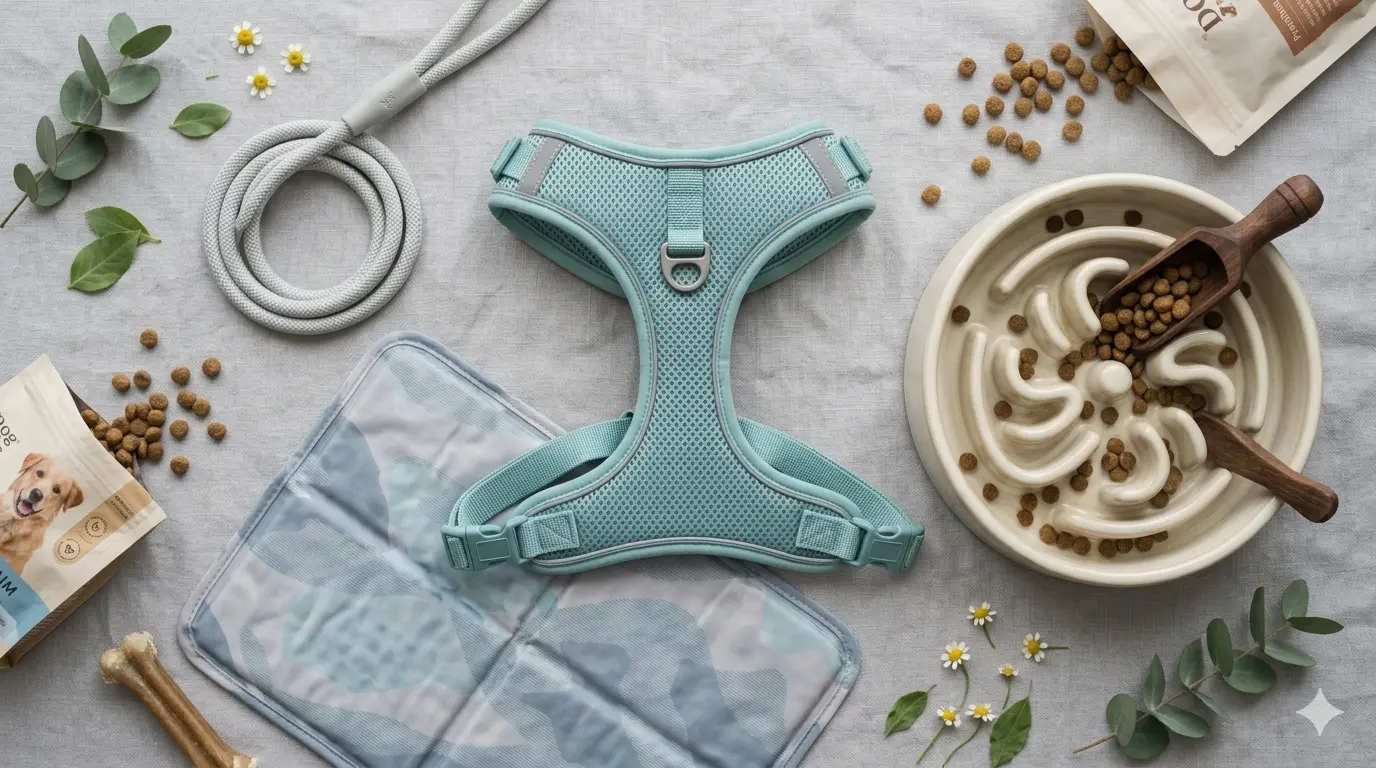
Our Brachycephalic Dog Care guide covers the why — the airway anatomy, the heat sensitivity, the training adjustments that come with owning a flat-faced breed like Tank. This guide covers the what: the actual gear categories worth spending on, what to look for within each one, and a few things worth actively avoiding. None of this is about buying more stuff for the sake of it — it’s about the handful of categories where the right gear genuinely changes day-to-day comfort and safety for these breeds.
Understanding What Makes Brachycephalic Dog Gear Different
Generic dog gear is usually designed around an average body shape and an average respiratory system, and brachycephalic breeds don’t really have either. A broader, shorter chest changes how a harness needs to fit. A less efficient airway changes how much margin for error exists around heat and exertion. A tendency toward faster eating and shorter, wider throats changes what “a bowl” needs to do beyond holding food. Brachycephalic dog gear, in other words, isn’t a marketing category invented to sell more products — the anatomical differences are real, and generic gear sized only by weight or breed-neutral assumptions tends to fit and function worse for this group.
Harnesses: What to Look For
A harness is the single highest-impact purchase for most brachycephalic dog owners, because it replaces a collar as the primary point of contact — and any pressure on the neck adds strain to an airway that already has less reserve than a longer-muzzled dog’s.
A few things matter more than brand or price point:
- Front-clip or dual-clip design. A front-chest attachment point discourages pulling without any pressure near the neck, which matters more here than for an average dog.
- Broad, padded chest coverage. Bulldogs and similar breeds carry more of their mass and width through the chest and shoulders than a typical mesocephalic dog, so a harness that distributes pressure across a wide padded panel avoids concentrating force in one spot.
- Fit-check before committing to a size. Sizing by weight alone is unreliable for this breed group — measuring chest girth directly and checking that two fingers fit flat between the harness and the dog’s body (adjusted at every strap, not just one) catches a poor fit before it becomes a chronic rubbing problem.
- Avoid tight neck openings. Some harnesses cinch snugly around the neck even with a front-clip design; for a breed already working harder to breathe, a wide, adjustable neck opening that doesn’t compress the throat is worth prioritizing over one that looks more “secure.”
We go deeper on one specific option that checks these boxes in our full review of the harness.
Breed-by-Breed Fit Differences
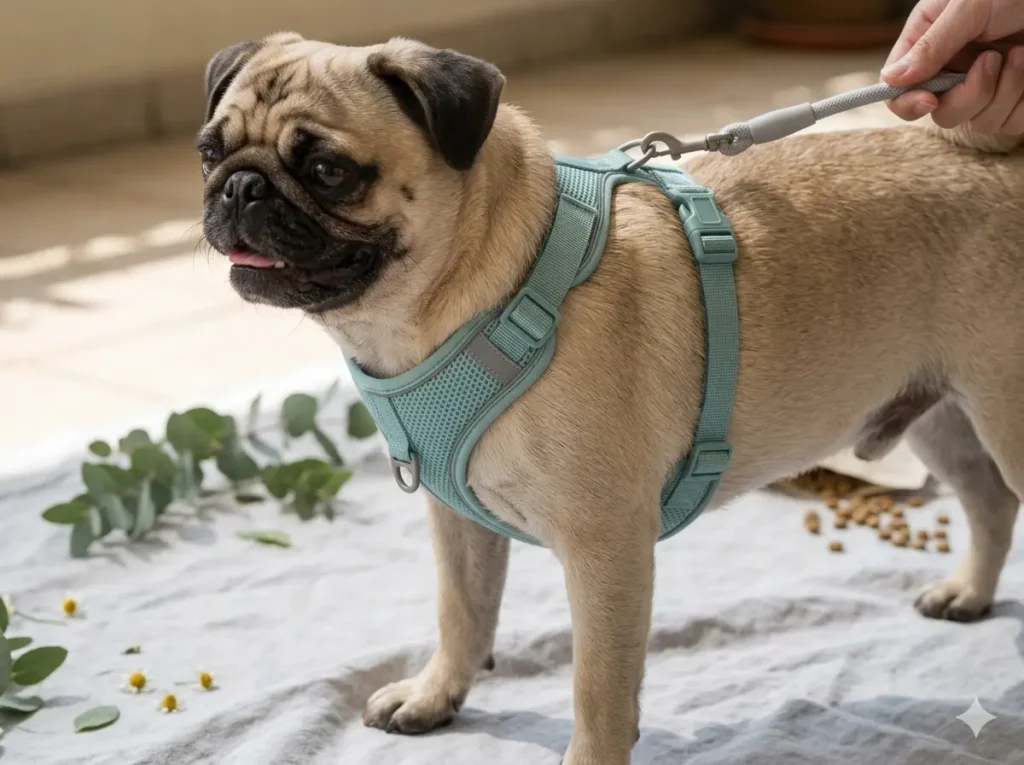
Even within “brachycephalic,” body proportions vary enough that a harness sized well for one breed can fit poorly on another. Bulldogs tend to be barrel-chested and low to the ground, which means a harness with a shorter torso length and extra girth adjustment room usually fits better than one designed for a more standard proportion. French Bulldogs are generally smaller and more compact but share the broad-chest tendency, so sizing charts based on weight alone often run large or small depending on how a specific dog’s chest-to-length ratio compares to the brand’s assumed average. Pugs and Boston Terriers, being smaller still, sometimes do better in harnesses designed for small-to-medium dogs generally, as long as the front-clip and wide-chest-panel criteria above are still met. The takeaway across all of these: measure the actual dog rather than relying on the “recommended for [breed]” label alone, since within-breed variation in body shape is often larger than people expect.
Cooling Gear: Vests, Mats, and Portable Fans

Cooling gear matters more for brachycephalic breeds than for most dogs, since panting — their main cooling mechanism — is measurably less efficient in this group. A few categories worth knowing:
Cooling vests typically work through evaporative cooling (soak, wring, and wear) and are most useful for active outdoor time in warm weather — walks, yard time, travel stops — rather than as an all-day solution.
Cooling mats (usually gel-filled or pressure-activated) give a dog somewhere to lie down and passively cool off indoors or in shaded outdoor spots, and tend to be the lower-effort, lower-cost entry point into this category.
Portable fans and battery-powered misters matter most for travel or outdoor events where shade and airflow aren’t guaranteed — a car, a patio, a dog show or park visit on a warm day.
None of these substitute for the basics (shade, water, avoiding peak heat hours) — they’re a supplement for situations where those basics alone aren’t quite enough.
What to Look for in Each Cooling Category
A cooling vest is only as useful as how quickly and thoroughly it can be re-soaked, so a design with a wide surface area and a fast-drying fabric tends to outperform a thicker one that holds more water but takes longer to reactivate once it dries out on a hot day. For cooling mats, pressure-activation (gel that cools on contact with body weight, no refrigeration needed) tends to be more practical for everyday use than a mat that has to be frozen or refrigerated ahead of time, simply because it’s ready whenever the dog wants to use it. Portable fans and misters are the most situational of the three categories — genuinely useful for travel, tailgate-style outdoor events, or anywhere shade isn’t guaranteed, but unnecessary for a dog whose outdoor time is already limited to cooler parts of the day in a shaded yard.
Feeding Tools: Slow Feeders and Raised Bowls
Brachycephalic breeds are prone to swallowing air while eating (aerophagia), which can contribute to regurgitation, bloating, and general digestive discomfort — a pattern noted across multiple sources on brachycephalic-specific care. Slow-feeder bowls, which use raised ridges or a maze pattern to physically prevent fast gulping, are one of the more consistently recommended tools for this issue, since they extend meal time and reduce the amount of air swallowed along with the food.
Raised or angled bowls are more debated. Some veterinary sources suggest a slight elevation reduces neck flexion and eases swallowing for a shortened muzzle, while others caution that raised bowls may be associated with increased bloat risk in some dogs — this is a case where checking with your own vet about your specific dog is more useful than a blanket rule either way.
Reading Slow Feeder Designs
Not all slow feeders work equally well for a shortened muzzle. Deep, narrow maze patterns designed for longer-nosed breeds can be genuinely difficult for a brachycephalic dog to navigate, sometimes leading to frustration rather than slower, more controlled eating. Shallower ridge patterns, or slow feeders specifically marketed for flat-faced breeds, tend to strike a better balance — enough obstruction to slow eating meaningfully, without requiring a nose shape the dog doesn’t have. Splitting a normal portion across a slow feeder and a small supplementary bowl is a reasonable workaround if a specific design turns out to be too difficult for a given dog.
Water and Travel Gear for Heat Safety
Portable water bowls, spill-resistant travel bottles, and simple accessories like a cooling towel for the car all matter more for this breed group given how much faster heat-related illness can escalate. A dog who overheats in a parked car or on an unexpectedly long errand run doesn’t have the same thermoregulatory buffer a longer-muzzled dog would, so gear that makes water and shade available on short notice — rather than gear that’s just nice to have — is worth prioritizing in this category specifically.
What to Avoid
A short list of gear worth actively skipping for this breed group:
- Choke chains, prong collars, or any neck-pressure correction tool — these add strain to an airway with less reserve than average, regardless of how they’re marketed for training. Our Dog Training guide covers reward-based alternatives that don’t rely on physical correction in the first place, which sidesteps this issue entirely.
- Retractable leashes for anything beyond calm, open-space walking — the sudden jerks they allow put unexpected pressure on the neck if a collar (rather than a front-clip harness) is attached, and the delayed reaction time makes it harder to intervene before a lunge happens
- Fully enclosed carriers without strong ventilation — airflow matters more for a dog who already pants less efficiently, especially during travel in warm weather; a carrier with mesh panels on multiple sides beats one with a single small vent
- Puzzle feeders that require significant nose or mouth pressure to release food — some designs assume a longer muzzle and normal airflow to operate as intended, and can be frustrating or counterproductive for a flat-faced dog; if you want food-based enrichment, a shallow snuffle mat generally works better than a deep, effortful puzzle toy
How to Prioritize Spend
If budget or timing means choosing one category first, a properly fitted harness is the highest-leverage purchase — it affects daily walks, training sessions, and general comfort every single day. Cooling gear becomes the next priority heading into warmer months or for households in hot climates. Feeding tools matter most for dogs already showing signs of fast eating, regurgitation, or digestive discomfort, and can reasonably wait for owners whose dogs aren’t showing those signs yet.
A rough way to think about tiers:
Essential, buy first: a properly fitted front-clip harness, a basic portable water bowl for outings.
Seasonal priority: cooling mat or vest if you live somewhere with a real summer, or if your dog already shows heat sensitivity signs covered in our Care guide.
Situational, buy if needed: slow-feeder bowl (if your dog eats fast or shows regurgitation), portable fan or misting fan (frequent travel or outdoor events), raised bowl (only after checking with your vet given the mixed guidance above).
Frequently Asked Questions
Do all brachycephalic dogs need every category in this guide? No. A dog with mild BOAS symptoms who lives in a cool climate and eats normally might genuinely only need a good harness. Treat this as a menu of options tied to specific needs, not a mandatory checklist.
Is it worth buying premium gear over budget options? For harnesses specifically, fit and material quality tend to matter more than price point once you’re above the cheapest tier — a well-fitted mid-range harness generally beats an ill-fitting expensive one. For cooling and feeding gear, the differences between budget and premium options tend to be smaller.
Is it safe to leave any of this gear on unsupervised? Cooling vests and mats are generally fine left accessible, but harnesses (like any properly fitted gear) are best removed during unsupervised crate time or overnight, mainly to prevent chewing or snagging rather than any brachycephalic-specific risk.
How do I know if my dog needs a slow feeder versus just eating slower on their own? If a dog regularly finishes a meal in under a minute, regurgitates shortly after eating, or seems to swallow audible air while eating, a slow feeder is worth trying. A dog who already eats at a relaxed pace doesn’t necessarily need one.
Where This Fits Into Everything Else on Furrowise
This buying guide pairs directly with our Brachycephalic Dog Care guide, which covers the underlying reasoning for all of these recommendations in more depth. We’ll continue expanding this cluster with individual product reviews — starting with the harness category, where we’ve published a full review breaking down fit, materials, and how it holds up against the criteria in this guide.
Editorial Note: This guide is based on published veterinary and clinical guidance on brachycephalic-specific care, manufacturer product information, and editorial analysis of that material — not hands-on testing of every category discussed here. Where a specific product has been reviewed with more detail, that’s noted and linked separately.
Disclaimer: This article is not veterinary advice. If your dog is showing signs of illness, distress, or a sudden behavior change, please consult a vet.